Daily volume creates seven editorial decisions
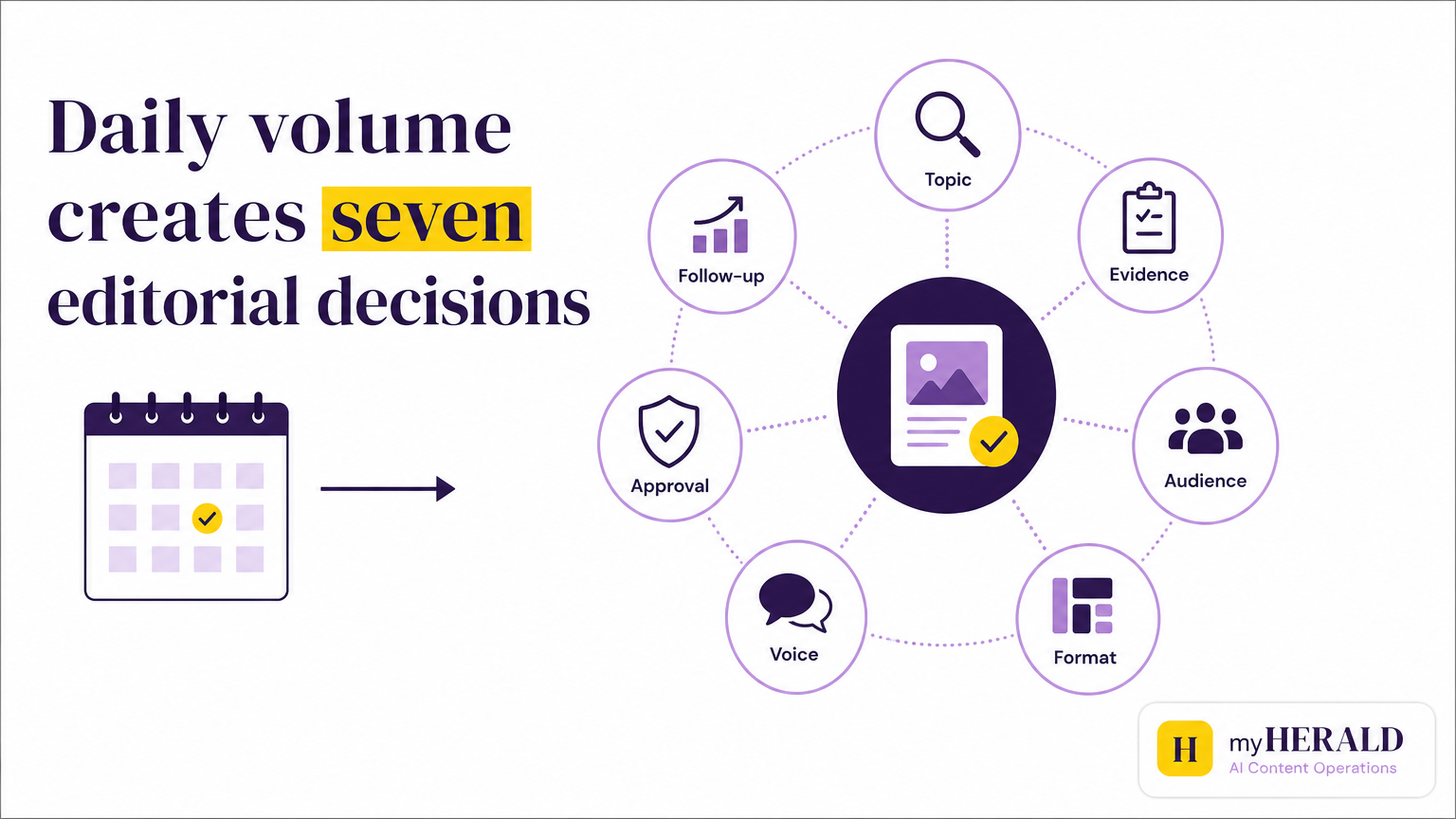
A single publishing slot looks small on a calendar. Behind it sit seven decisions: topic, evidence, audience promise, format, voice, approval, and follow-up.
That is the operational tax of daily volume. The visible output is one post. The work is the chain around it. For a marketer-of-one, multiplying the slots multiplies the decisions, review points, and chances to publish something that is technically finished but strategically thin.
The answer is not to abandon consistency. It is to design a cadence that protects judgment. Weekly cadence done well beats daily volume because it gives one idea enough room to be researched, shaped, checked, approved, and learned from.
Why frequency creates hidden work
The pressure to produce more is real. HubSpot's 2026 State of Marketing reports that 61% of marketers say marketing is experiencing its biggest disruption in 20 years. Jasper's State of AI in Marketing 2026 says 57% of 1,400 marketers plan to focus on scaling content production and operations, while 95% plan to increase AI spending.
Those figures describe a market reaching for more capacity. They do not prove that daily publishing is wrong. They do show why the operating model matters. Scaling output without protecting the decisions around it creates a queue of half-resolved choices.
Brafton's AI Content Creation Survey surveyed 132 marketers using AI and reached a practical conclusion: AI workflows still need subject-matter, editorial, SEO, and brand review. A draft can arrive quickly and still create work downstream if nobody has decided what it should prove, who it is for, or what standard it must meet.
That is the difference between writing faster and operating better.
The seven decisions behind every post
A post is rarely one task. It is a small editorial system.
-
Topic: What deserves attention now, and what can wait? A broad subject is not yet a useful idea. The topic needs a boundary.
-
Evidence: What supports the point? This may be a customer observation, an internal result, a named study, or a clear argument. Without an evidence standard, research becomes an open tab collection.
-
Audience promise: What will the reader understand, decide, or do differently after reading? A post cannot serve every audience equally well.
-
Format: Does the idea need a short observation, a worked example, a checklist, or a longer explanation? The format controls how much reasoning the idea can carry.
-
Voice: What should this sound like? Voice is not a final polish pass. It changes the words chosen, the examples used, and the confidence of the claim.
-
Approval: What must be checked before publication? Facts, positioning, brand language, legal boundaries, and the simple question of whether the argument is worth making all belong here.
-
Follow-up: What happens after the post goes live? Distribution, replies, measurement, and the next editorial decision determine whether the piece becomes learning or disappears into the feed.
Daily volume repeats this system for every slot. The post may take minutes to read. The decision load remains.
What a weekly cadence protects
A weekly cadence works when it protects the whole chain, not when it simply moves seven rushed posts into one batch.
The operating difference is straightforward:
| Daily-volume model | Weekly-cadence model |
|---|---|
| Start with an empty slot | Start with one useful question |
| Optimize for filling the calendar | Optimize for a clear audience promise |
| Review grammar at the end | Set the evidence standard before drafting |
| Move to the next post immediately | Carry the learning into the next piece |
The weekly model gives judgment a place on the calendar. Early in the week, choose the question and define what a good answer must contain. Next, gather only the evidence that serves that answer. Then shape the argument, check the claims, and remove anything that does not earn its place.
After publication, look at more than reach. Did the right people recognize the problem? Did someone use the idea in a decision? Did the response reveal a better question for next week? Those observations are part of the content operation, not optional extras for a quieter day.
This is also where a quality floor becomes useful. A weekly piece should be able to answer four basic questions:
- Is the point specific?
- Is the evidence adequate for the claim?
- Is the reader clear on why it matters?
- Has someone with context approved it?
If the answer to one of those is no, a full calendar will not rescue the post. It will only make the gap recur more often.
The objection: daily visibility feels safer
The strongest case for daily publishing is not vanity. It is fear of disappearing. A lean team may think that more slots create more chances to stay visible, learn what resonates, and keep the brand present.
That logic has a limit. Visibility without a point of view is easy to produce and hard to remember. More posts can also spread the review effort so thin that every piece becomes acceptable, but none becomes useful.
A weekly cadence does not mean going silent for six days. It means giving one core idea enough attention to travel. That idea can become a blog article, a social post, a reply, or a conversation. The unit of work is still the argument. The platforms are distribution choices around it.
Consistency matters because readers need a reason to return. Consistency does not require pretending that every calendar slot deserves equal weight.
A better definition of throughput
Daily volume is attractive because it turns work into a clean count. Seven posts looks measurable. Seven fully considered arguments is harder to count, but it is closer to the value a lean team is trying to create.
The useful operating metric is not how many slots can be filled. It is how many editorial decisions the team can make well without losing the thread of its point of view.
That metric changes the planning conversation. Instead of asking how to create more drafts, ask which decisions should happen once and be reused. Instead of adding another slot, ask whether the current idea has been researched, reviewed, distributed, and learned from. Instead of treating approval as a bottleneck, treat it as part of the product the audience receives: a clearer, more trustworthy argument.
The point is not to publish less as a badge of restraint. It is to stop pretending the post is the unit of work. The unit of work is the seven decisions, and a cadence is sound only when those decisions get the attention they deserve.
Weekly cadence done well beats daily volume.
Sources
Ready to automate your content operations?
myHERALD researches, writes, reviews, and publishes. So you can focus on strategy.
Try myHERALD Free