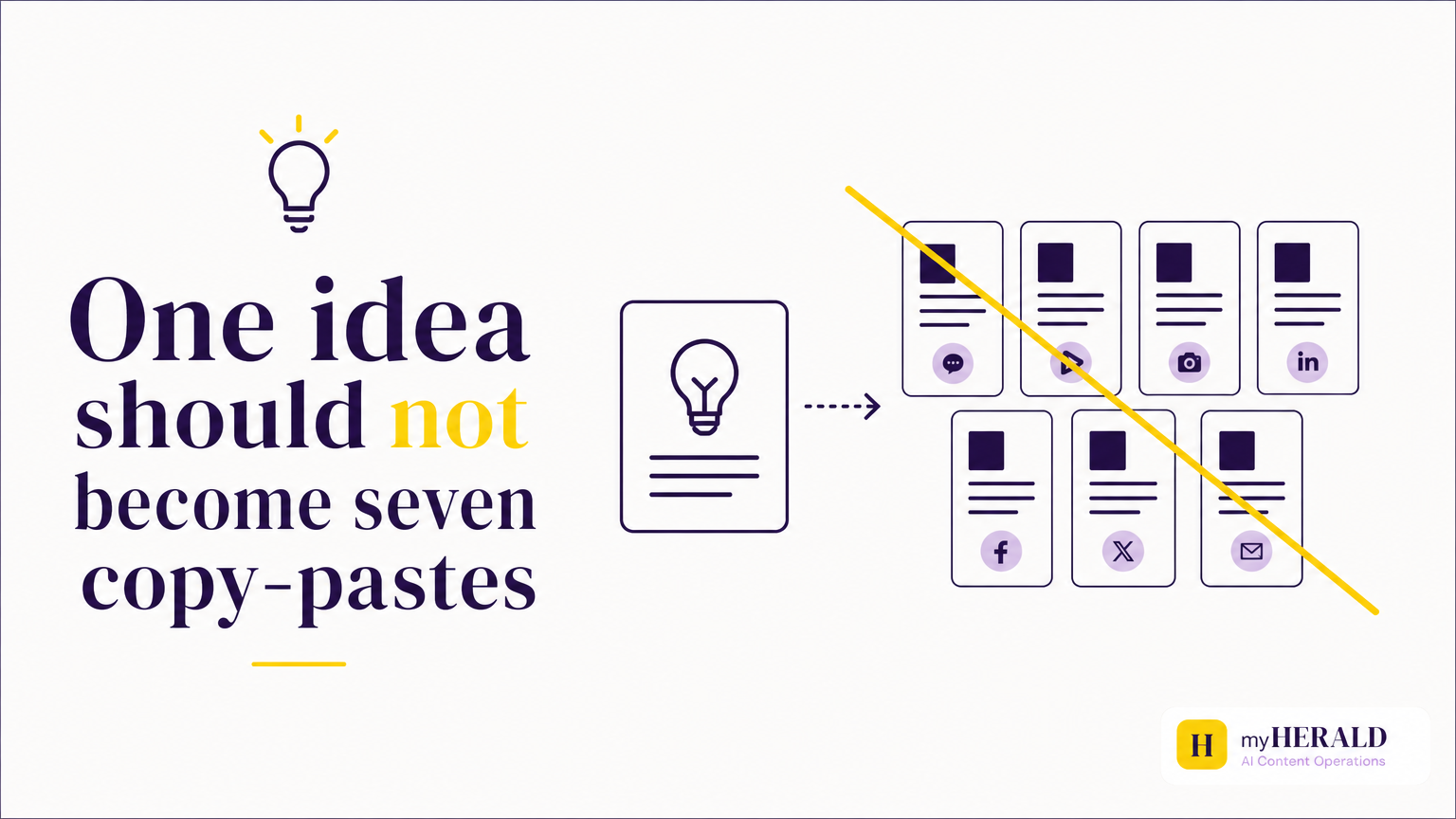
One idea should not become seven copy-pastes
On June 12, the myHERALD changelog documented a small operational shift: Autopilot could take a weekly plan, draft a post for each platform in that platform's own style, and line the pieces up against the posting targets. Platforms not connected yet could still be planned for manual posting.
That detail matters because distribution is often treated as duplication. Write the idea once, paste it seven times, adjust a hashtag or two, and call the work done. The result is efficient in exactly the way a photocopier is efficient: it reproduces the original, including anything that does not belong on the next page.
The better unit of work is the idea. The output is a set of native pieces.
The idea is the source of truth
Seven platform outputs should share one argument, not one block of pasted text.
An idea has a centre. It might be a product lesson, a point of view, a customer problem, or a useful explanation. That centre should survive every adaptation. The wording around it should not.
This distinction is easy to describe and surprisingly easy to lose. Teams often preserve the sentence instead of the meaning. They keep the opening, the paragraph order, the call to action, and the rhythm, then make small cosmetic changes for each channel. The result looks consistent in a planning document and out of place everywhere it appears.
A source idea should carry the parts that need to remain true:
- the claim being made
- the evidence behind it
- the audience problem it addresses
- the action or conclusion the reader should take away
Everything else is available for change. Length. Framing. Pace. Examples. The amount of context. Even the order of the argument.
That is how one idea becomes a coherent set of pieces rather than seven echoes.
Native adaptation is a translation problem
Native adaptation means preserving the claim while changing its shape for seven different reading contexts.
The myHERALD product description frames the system around researching, writing, fact-checking, and publishing in one operation. The editorial equivalent is simple: establish the substance once, then translate it into the job each destination needs to do.
| Destination | The piece needs to do |
|---|---|
| Blog | Develop the argument, explain the mechanism, and answer the obvious follow-up questions |
| Make the point quickly, with enough context for a professional reader to recognise the problem | |
| X | Compress the idea until the sharpest claim can stand on its own |
| Threads | Give the thought room to unfold in a conversational sequence |
| Bluesky | Keep the wording compact and the point legible without excess setup |
| Let the visual carry part of the meaning, while the caption supplies context | |
| Present the idea plainly, with enough detail to make the post useful without the original article |
The table is not a set of seven templates. It is a set of seven editorial jobs.
A LinkedIn version may begin with the moment that exposed the problem. The blog version can spend several paragraphs defining the problem and showing its consequences. The X version may keep one line of tension and remove everything else. The Instagram version may need a visual idea before it needs a caption.
The point is not to make every piece feel unrelated. The point is to make each one feel native while the underlying argument remains recognisable.
Approval is part of the system
The June 12 changelog entry is explicit about the boundary: the weekly plan can line up drafts, but everything still waits for approval.
That boundary matters. Automation should remove copying, not judgment.
A content operation needs a person to decide whether the idea is worth publishing, whether the claim is fair, and whether the piece sounds like the organisation behind it. Those decisions belong before distribution, not after a batch of near-identical captions has already gone live.
The useful division of labour is therefore clear:
- a human sets the direction and approves the result
- the system carries the idea across the planned destinations
- each version changes to fit its platform
- the final pieces remain connected to the approved source
That is a much healthier model than asking one person to act as strategist, writer, formatter, scheduler, and quality-control desk for every single channel.
A four-part model for keeping the idea intact
A small team does not need a complicated content framework. It needs a clear boundary between what is fixed and what is flexible.
-
Define the central claim.
Write the idea in one or two sentences before writing any channel version. If the claim is vague, multiplying it across platforms only creates more vague content.
-
Mark the non-negotiables.
Keep the facts, evidence, product details, and conclusion that every version must preserve. This is the editorial spine.
-
Give each platform a job.
Decide what the reader should get from the version on that destination. A blog may explain. A social post may sharpen. A visual may make the relationship between two ideas obvious.
-
Review meaning before polish.
First check whether every version still says the right thing. Then check whether it sounds natural on its platform. A polished copy-paste is still a copy-paste.
This model prevents two common failures. The first is flattening, where every channel receives the same paragraph. The second is drift, where the adaptations become so different that they no longer belong to the same idea.
What the operation should remove
The tedious part of multi-channel publishing is rarely the thinking. It is the repeated handling of the same idea: moving text between documents, rewriting context that was already settled, checking whether a platform version exists, and trying to remember which draft is current.
Those are useful tasks to systematise because they do not deserve a fresh act of creativity every time.
myHERALD's public product positioning is built around that operational layer. It researches, writes, fact-checks, generates images, and publishes through one content operation, while the human remains responsible for direction and approval. The benefit is not that one sentence gets sprayed across seven channels. The benefit is that one approved idea can move through a controlled process and emerge in forms that fit where they will be read.
That distinction also makes quality easier to inspect. You can ask two separate questions:
Does every version preserve the approved idea?
Does every version belong on its destination?
If the answer to the first is no, the adaptation has drifted. If the answer to the second is no, the adaptation has been lazy. Both are editorial problems, even when the scheduling is working perfectly.
One idea, properly carried
A strong idea should create a family of pieces, not seven identical echoes.
The editorial work is deciding what must stay true and what should change. Once that boundary is clear, distribution stops being seven copy-paste jobs and becomes one well-run operation.
Sources
Ready to automate your content operations?
myHERALD researches, writes, reviews, and publishes. So you can focus on strategy.
Try myHERALD Free