The weekly cadence compounds editorial judgment
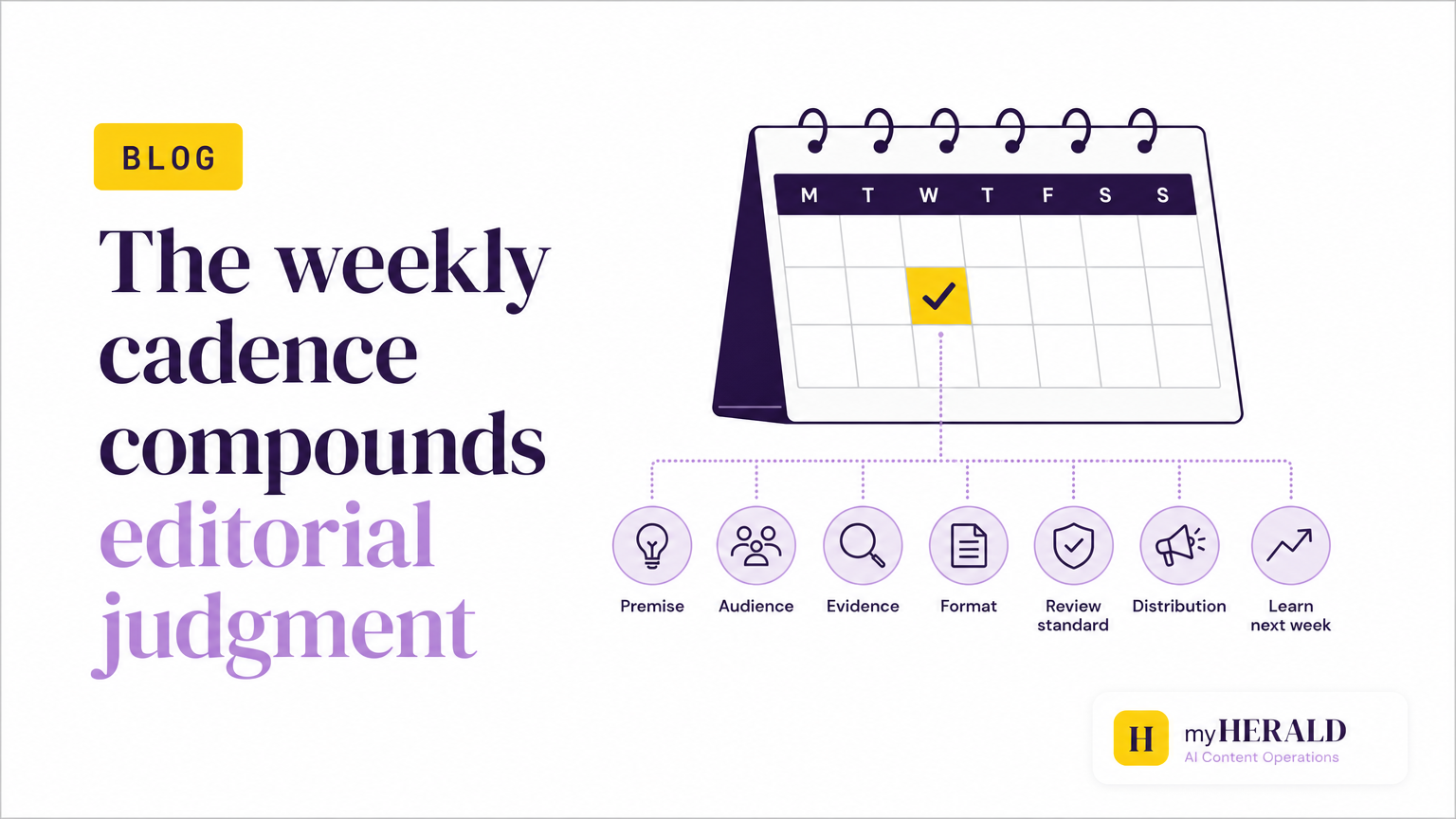
A content slot looks like one line on the calendar. In practice, it carries seven decisions: the premise, the audience, the evidence, the format, the review standard, the distribution, and what the response should teach next week.
That is why a weekly cadence can beat daily volume. A week gives each cycle enough room to make a decision, observe the result, and carry the learning forward. Daily publishing often produces more finished pieces but fewer durable decisions.
A cadence is not a calendar. It is a memory system for better decisions.
Why weekly work compounds
The useful output of a piece is not only the piece itself. It is the judgment left behind.
Which premise made the subject clear? Which example earned trust? Which objection appeared in the comments? Which format helped the idea travel? Which source was strong enough to reuse? If those answers disappear when the post is published, the next brief starts from zero.
A weekly rhythm creates a small but important operating loop:
publish, observe, record, adjust, publish again.
The compounding effect does not come from the word “weekly.” It comes from carrying evidence from one cycle into the next. The cadence gives a small team enough space to notice what happened before rushing to fill the next slot.
That distinction matters because the pressure to produce is real. HubSpot’s 2026 State of Marketing reports that 61% of marketers see the current period as marketing’s biggest disruption in 20 years. Jasper’s 2026 survey of 1,400 marketers reports that 57% are prioritizing scaling content production and operations, while 95% expect to increase AI spending.
Those figures describe a market reaching for more output. They do not prove that more output produces better judgment. Scaling production without preserving learning just creates more opportunities to repeat the same weak decision.
The seven decisions inside a content slot
A weekly cadence works when the slot is treated as a decision system, not a publishing chore. These seven decisions make the learning visible.
-
Choose the question. Start with one question the audience actually needs answered. A topic is broad; a question gives the work a job.
-
Choose the audience. Name the person who should recognize the problem. “Marketers” is usually too vague. A marketer-of-one with two hours for content faces a different decision from a demand-generation team with a full production calendar.
-
Choose the evidence. Decide what can support the argument before drafting around it. Use a first-party observation when one exists. For borrowed claims, name the source in the sentence and keep the scope intact.
-
Choose the format. Match the shape to the idea. A practical framework may need a carousel or checklist. A narrow opinion may need one clean paragraph. Format is part of the argument, not decoration added at the end.
-
Choose the review standard. Decide what “ready” means before the draft arrives. Does every number have a source? Does the opening make a concrete point? Does the piece sound like the organization? A review gate turns taste into a repeatable standard.
-
Choose the distribution. Publish where the intended reader can use the idea. Adapt the core argument to the platform instead of treating every channel as a storage location for the same copy.
-
Choose what to learn. Write down the signal that matters before the post goes live. It might be whether the premise was understood, whether the example prompted useful replies, or whether readers saved the framework. The metric is less important than making the question explicit.
The seventh decision is the one most calendars omit. It is also the one that makes the next week cheaper.
A weekly alternative to daily volume
A weekly cadence has five stages, from question to learning. It does not mean disappearing for six days. It means giving one core idea a deliberate path from question to learning.
| Moment | Decision | Useful output |
|---|---|---|
| Start of the week | What deserves attention now? | One audience question and one working premise |
| Research and drafting | What supports the premise? | Evidence, examples, and a complete draft |
| Review | What would make this trustworthy and recognizably ours? | A corrected, source-aware piece |
| Publication | Where will this idea be useful? | A native version for the chosen channel |
| End of the cycle | What changed our understanding? | A short note for the next brief |
This is a smaller system than daily production, but it leaves behind more than a row marked “published.” It leaves a decision, a source, an objection, or a useful constraint.
The following week should not begin with “What can we post?” It should begin with “What did the last cycle teach us, and what follows from it?”
What to measure when the goal is judgment
Four signals are enough to start: premise clarity, substantive response, source quality, and what can be reused.
Track whether the intended reader understood the premise. Note which sentences or examples were quoted back. Record substantive objections, not only the total number of reactions. Keep the sources that held up and replace the ones that did not. Mark which ideas can become a brief, a visual, or a sharper follow-up.
This is also where measurement is widening beyond clicks. HubSpot’s guidance on AI visibility describes a surface that includes prompts, brand visibility, competitor presence, citations, and cited content types. A weekly content system should leave room to notice those signals instead of treating publication as the finish line.
The point is not to build a larger dashboard. It is to make the next editorial decision better than the last one.
The compounding effect is editorial memory
Daily volume has an obvious advantage: it fills the calendar. A weekly cadence has a less visible advantage: it improves the person or system making the decisions.
That improvement accumulates. A clear premise becomes easier to spot. Weak evidence gets rejected earlier. Review becomes faster because the standard is written down. Distribution becomes deliberate because the audience and format are part of the brief. The archive becomes useful because it contains reasons, not only URLs.
Jasper’s 2026 survey captures the production pressure. HubSpot’s research captures the disruption around it. Neither changes the operating truth for a small team: every piece still needs a good decision behind it.
Weekly cadence done well beats daily volume because each cycle has a chance to make the next one smarter.
Sources
Ready to automate your content operations?
myHERALD researches, writes, reviews, and publishes. So you can focus on strategy.
Try myHERALD Free