Every post needs an evidence trail
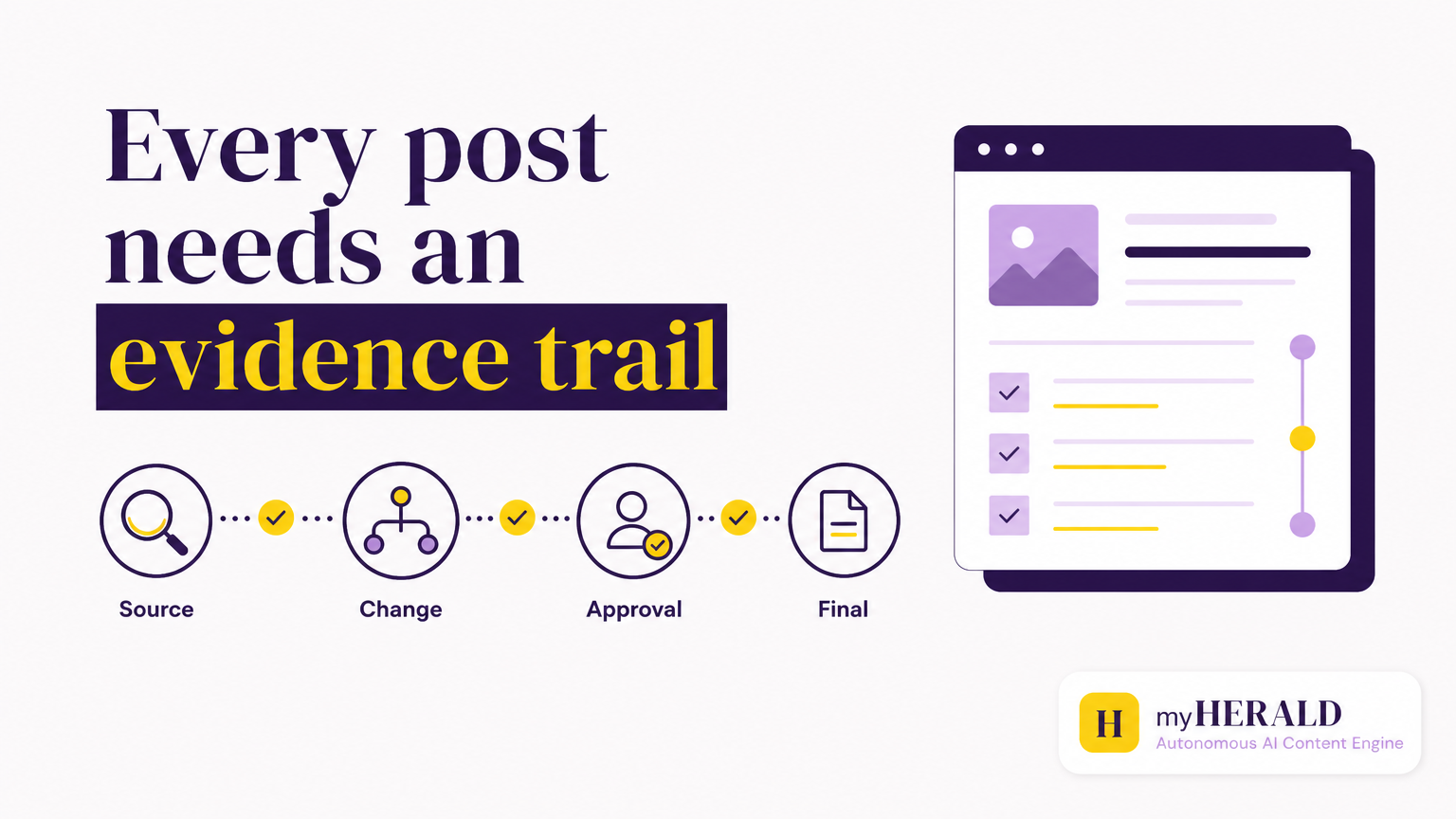
A published post should answer more than “what did we say?” It should also answer “where did this claim come from, what changed, and who approved the final wording?” NIST’s Generative AI Profile treats governance and content provenance as risk-management concerns. For a lean marketing team, that principle is practical: keep the reasoning close enough to the content that someone can recover it later.
Why the published sentence is not enough
The sentence on the page is only the last visible frame of an editorial decision. The source may be in a browser tab, the rationale in a chat thread, the revision in a document called final-final, and the approval in a message nobody can find six months later.
That is how content becomes difficult to update. A statistic changes. A customer asks where a claim came from. The person who wrote the post is away. The team has the copy, but not the context that made the copy defensible.
The 2026 B2B research from Content Marketing Institute and MarketingProfs surveyed 1,015 marketers. It reports quality content as a challenge for 28% of respondents, differentiation for 24%, and collaboration for 21%. Those are not separate editorial problems. They compound when the work leaves no usable memory behind. A team that cannot explain a claim also has a harder time improving it.
An evidence trail does not make every sentence true. It makes the editorial path visible enough to inspect, revise, and hand over.
What an evidence trail should preserve
A useful evidence trail has five parts: the brief, the supporting source, the reason the source matters, the meaningful revisions, and the human decision to publish.
-
The brief records the job the content was meant to do. It captures the audience, angle, and intended outcome, so a future editor can tell whether the post is still solving the right problem.
-
The source stays attached to the claim it supports. A homepage link is not enough if nobody knows which passage or figure mattered. Name the source and preserve the relevant context.
-
The rationale explains selection. Two sources can point in the same direction while carrying different weight, scope, or limitations. The reader needs to know why one made it into the draft.
-
The revision history shows what changed. A removed sentence can matter as much as the sentence that survived, especially when a claim was narrowed during review.
-
The approval identifies the person who made the final call. Automation can prepare and move work. Responsibility still belongs to a human.
This is editorial provenance. It is broader than asset provenance. The C2PA specifications describe a technical way to record assertions about an asset’s history. That is useful, but an asset credential does not independently prove that a statistic is accurate or that a person approved the wording. A trustworthy content record needs both the material history and the decision history.
How a governed content operation keeps context attached
myHERALD’s public walkthrough describes seven stages: Ask, Research, Write, Review, Approve, Schedule, and Publish. The important detail is not the number seven. It is that research and review remain part of the same operation as drafting, and nothing goes out without the user’s approval. See the myHERALD product overview for the public workflow.
In the research stage, Skills, the Knowledge Hub, and live web sources provide the working context. The review stage checks claims against sources and the brand guide. A person can edit inline, request changes, or approve with one click. Approved pieces then move to the calendar.
That sequence changes the meaning of “approved.” Approval is not an invisible thumbs-up at the end of a long chain. It is a named decision connected to the brief, the research, the draft, and the review outcome.
The distinction matters because connected context is not the same as immutable compliance evidence. A content operation can preserve a useful record without claiming that the record is tamper-proof, legally sufficient, or automatically compliant. Precision is part of trust.
Why recoverability matters for lean teams
The EU AI Act describes human oversight in proportion to risk, autonomy, and context. That is a better frame for marketing teams than a universal promise that every workflow needs the same control. A product launch claim, a technical explanation, and a casual opinion do not carry identical consequences. The discipline is to make the decision visible enough for the situation.
Recoverability pays off in ordinary moments:
- A statistic changes, and someone can find the claim, source, and review context without rebuilding the research.
- A teammate takes over, and the original intent is clear without searching through private messages.
- A post needs a new format, and the team can repurpose the reasoning instead of copying the wording blindly.
- A customer challenges a claim, and the team can inspect the source and explain the choice.
- A future editor spots a weak assumption and can improve the record rather than repeat it.
This is operational memory. It is especially valuable when content is one job among ten and the person who made the decision is not always available.
The benefit is not that the team never has to think. The benefit is that thinking does not disappear when the draft is finished.
NIST makes provenance and governance part of the conversation around generative AI. For content teams, the practical translation is simple: do not store only the sentence. Store enough of the path behind the sentence to make the work reusable.
A good content system should let a reader move backward from publication to source, brief, revisions, review, and human approval. That trail supports better updates, cleaner handoffs, and more honest conversations about what the system knows and what the editor decided.
Fast content is useful. Traceable content is reusable.
What would your team discover if it tried to reconstruct the reasoning behind its last published claim?
Sources
Ready to automate your content operations?
myHERALD researches, writes, reviews, and publishes. So you can focus on strategy.
Try myHERALD Free