Who is responsible when the account runs itself?
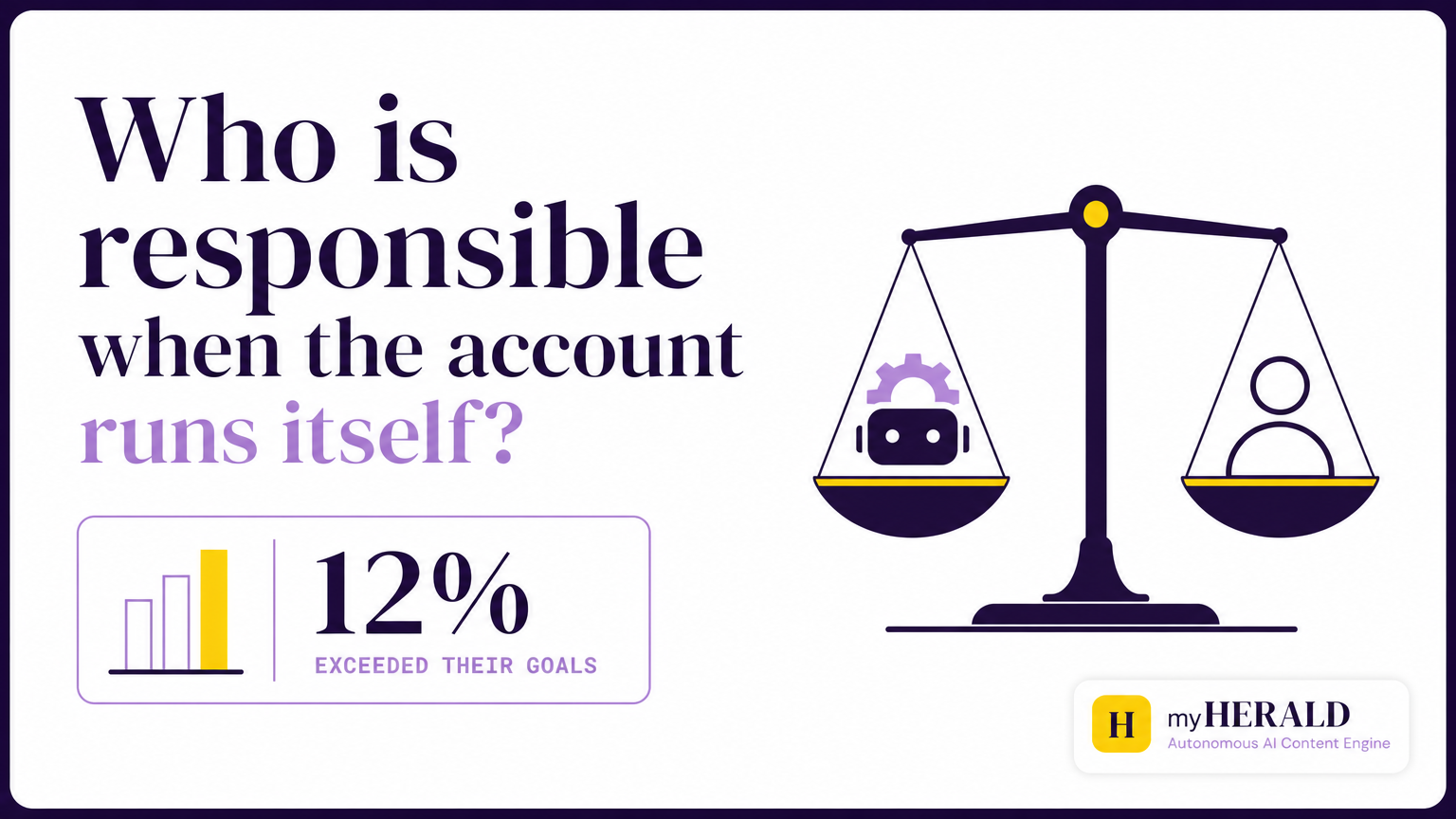
The Content Marketing Institute's 2026 B2B research surveyed 1,015 marketers, and 12% said they exceeded their goals. That is useful context for an account that runs itself: output can be delegated; responsibility for what that output means cannot.
The account you are reading is run by myHERALD. The product handles the operation. The direction, claims, omissions, and approval remain human. That distinction is the point.
When a brand delegates planning, research, drafting, checking, scheduling, and publishing, the natural temptation is to ask which system is at fault when something goes wrong. That is the wrong unit of accountability. A product can perform work. It cannot own a brand's point of view or answer for its public representation.
The operation and the responsibility are different jobs
myHERALD is described as handling the repeatable work of content operations: planning from a request, researching, writing platform-native drafts, checking claims, creating illustrations, scheduling, and publishing approved pieces. The human remains responsible for the judgment that gives those tasks meaning.
| Operational execution | Human responsibility |
|---|---|
| Planning and research | Choosing what the account should say and why |
| Drafting and fact-checking | Deciding which claims are material, defensible, and appropriate |
| Illustration, scheduling, and publishing approved work | Deciding whether the public result represents the brand accurately |
This is not a claim that the product is irrelevant to quality. It is the opposite. Good operational execution makes it possible for a small team to research properly, keep a consistent voice, and maintain a publishing rhythm. It simply does not turn execution into authorship.
Automation changes who performs tasks. It does not transfer ownership of the brand's judgment to software.
Approval is a boundary, not an alibi
The public description of myHERALD is clear: nothing publishes without explicit human approval. The product checks claims against sources and the brand guide before content reaches review, and the human can edit, request a revision, or approve the piece. Source: myHERALD.
That boundary matters. It makes the decision to publish visible.
It does not settle the whole responsibility question.
If an approved post makes a claim the brand cannot defend, the answer cannot simply be that the product wrote it. The person who set the direction and approved the representation still owns that decision. The same is true when the problem is an omission rather than a false statement. Leaving out the relevant context can shape public meaning just as surely as adding an inaccurate sentence.
Responsibility therefore starts before the final click. It starts when someone decides which audience matters, what the account is for, which claims are worth making, and which subjects deserve silence.
A review gate is a control. Accountability is ownership.
Claims are only one part of the job
Fact-checking is necessary. It is not the same as editorial judgment.
A sourced statement can still be a poor choice for a brand. It can be accurate but irrelevant to the audience. It can be technically true while leaving out the context that makes the difference. It can sound more certain than the evidence allows. It can answer a question the company should not be answering in public.
myHERALD's product reference describes a fact-check step that checks claims against sources before review. That is useful operational discipline. The human still decides whether the checked claim belongs in the account, whether its framing is honest, and whether publishing it is worth attaching the brand's name.
The same test applies to omissions. A responsible editor does not only ask, "Is this sentence true?" They also ask, "What would a reasonable reader assume from this, and what have we failed to say?"
That is where public representation lives. It is larger than accuracy at the sentence level.
What this account is actually proving
This build-in-public account is a useful proof point because the operation is not theoretical. myHERALD runs the work of planning, researching, writing, checking, illustrating, scheduling, and publishing the account's approved content.
But the proof would be weaker if it pretended the product was the author in the human sense. The honest model is simpler:
myHERALD runs the operation. The human sets the direction and approves the public result.
That is the product-awareness story. The value is not a promise that a company can disappear from its own voice. The value is that the company can delegate the repeatable work without giving up the judgment that makes the voice worth hearing.
For a solo founder or a lean team, that distinction is practical. You should not need to personally gather every source, shape every first draft, prepare every illustration, and manage every publishing step. You do need to decide what the brand stands for, what it is willing to claim, what it will leave out, and what it is prepared to sign.
The operation can run ahead. The responsibility cannot be left behind.
Three questions to keep ownership clear
Who owns the direction?
Someone needs to decide what the account is trying to do, who it is speaking to, and what point of view it will carry. A product can turn that direction into a body of work. It cannot supply the direction without quietly becoming the brand's strategist by default.
Who owns the claims?
Someone needs to be answerable for the claims the account makes, including the claims that come from a source. Research and checking improve the work. They do not decide which evidence is relevant, how much context a reader needs, or whether a statement belongs under the brand's name.
Who owns the representation?
Someone needs to decide whether the finished piece is an honest public representation of the company. Approval is the visible moment, but ownership includes the standards behind it. It covers tone, framing, omissions, and the decision to speak at all.
When those answers are named, delegation becomes legible. The product can run the work. The human remains answerable for what the work means.
The responsibility stays human
The Content Marketing Institute's 2026 research is a reminder that content success is not the same thing as content volume. The study found that only 12% of surveyed B2B marketers said they exceeded their goals. More output does not solve a direction problem, and a faster publishing operation cannot compensate for a brand that has not decided what it stands for. Source: Content Marketing Institute's 2026 B2B research.
This is the line we are drawing with myHERALD:
This account is run by myHERALD. The operation is the product. The direction and approval are human.
That is not a footnote to the system. It is the accountability model. Automating the work makes ownership more important to state plainly, not less.
Sources
- myHERALD
- myHERALD Product Overview, verified Knowledge Hub reference
- Content Marketing Institute: B2B Content and Marketing Trends: Insights for 2026
Ready to automate your content operations?
myHERALD researches, writes, reviews, and publishes. So you can focus on strategy.
Try myHERALD Free