Everything we published this week was planned by the machine and approved by a person
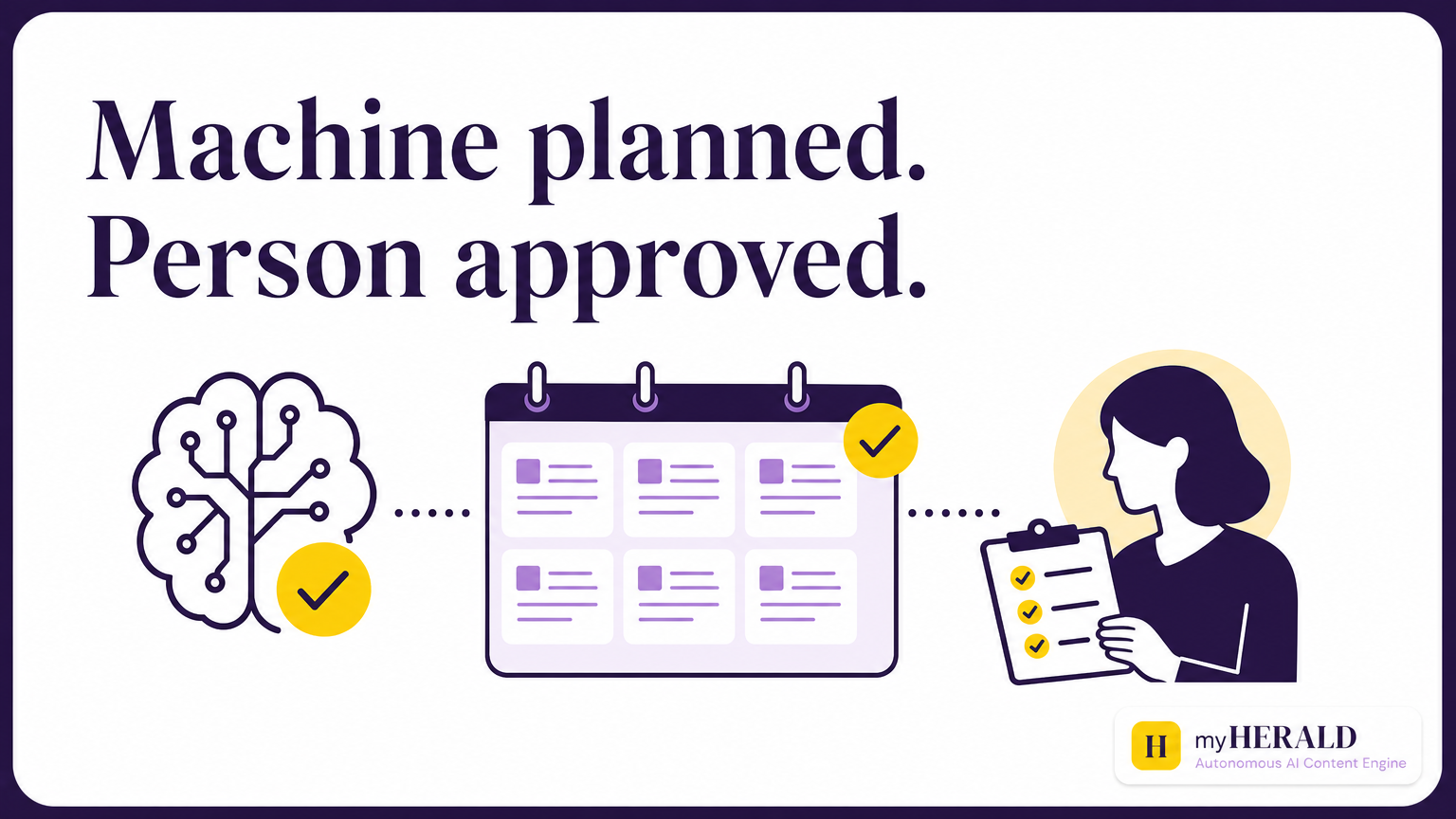
A confession, since we are being honest here: this account is run by myHERALD. Everything we published this week, the post you read on Threads, the one on Bluesky, the caption on Instagram, was planned in a single pass by our weekly planning mode. Then a person sat down, read each card, and decided what was allowed to go out. Nothing published on its own. That is the whole point.
We call the planning mode Autopilot, though the name oversells the drama. It is not a robot with opinions. It is a way to plan a week of content in one sitting instead of seven.
What actually happened this week
On Monday, Autopilot ran. It looked at what we have been talking about, what is worth saying next, and what each platform rewards. Then it drafted the coming week's posts as review cards on a board: a native draft for the blog, and native versions for each social account, each written for how that platform actually reads rather than one post copy-pasted five times.
By the time a human opened the board, the week was already sitting there in draft. Not published. Drafted. Every card had a spot to edit inline, ask for a rewrite, or approve. So the human work stopped being "stare at a blank calendar on Monday and fill it" and became "read what is proposed and decide."
That is a smaller job, and a more honest one. The direction is still ours. The taste is still ours. The machine did the part that is mostly logistics: turning one week of intent into thirty native drafts, on brand, in one pass.
The line we do not cross
Here is the part we want to be plain about, because it is the part that matters most and the part most easily oversold.
Nothing publishes without explicit human approval.
Not "usually." Not "unless it is confident." Every single card that went live this week was read by a person and approved by a person before it left the building. The approval is not a formality we click through. It is the product working as designed. myHERALD runs the operation. The human is the editor and the director.
We built it this way on purpose. Autonomous content that publishes itself is not a feature, it is a liability with a nice dashboard. The interesting problem was never "can a machine post for you." Machines have been able to post for years. The interesting problem was "can a machine do the ninety percent that is drafting and scheduling and formatting, and leave the ten percent that is judgment entirely to you." That ten percent is where a brand lives or dies. We are not automating it away.
Why the drafts are native, not generic
A thing we care about, and the reason a single planning pass is worth anything at all: the drafts are written for each place they land.
The blog post opens with a lede and breathes across sections. The Threads post is short and has a point. The Bluesky version has a community tone. The Instagram caption earns its first line. This is not one message pushed through five pipes. It is one idea, told the way each audience actually reads. When a human approves a card, they are approving something that already fits, which is most of why the review goes fast.
For this account, those drafts publish natively to several platforms once approved: X, Bluesky, Threads, Facebook, and Instagram. That is us dogfooding, running our own content operation the way a customer would run theirs. We think you should be able to see the thing working before you trust it, so we are pointing at our own board rather than a demo video.
What Autopilot is not
It is not a strategy that had an idea. Every topic this week traces back to a human decision about what we wanted to say. Autopilot planned the execution, not the intent. If a week's content is good, the credit is shared; if it is off, that is on us for approving it. We would rather own that than pretend a model made a call it never made.
It is also not set-and-forget. Someone still reads every card. On a light week that is a few minutes. On a heavy one it is a real editorial pass. The time saved is in the drafting and the coordinating, not in skipping the judgment. Anyone selling you the judgment-skip is selling you a way to publish things you did not read.
The honest version of the pitch
We could have written this week's posts by hand and never mentioned any of it. We publish natively across several platforms; you would not have known. We are telling you because the build-in-public version is more useful than the polished one, and because the mechanism is the point we are actually proud of.
A whole week of native, on-brand content, planned in one pass. Then a person approves each card, one at a time, and only the approved ones go out. That is what ran this account this week. It is what myHERALD does. And the human sitting at the approval gate is not a safety net bolted on after the fact. They are the director. The machine just made sure they had a full week to direct.
myHERALD is launching soon. If a content operation you actually control sounds better than a content operation that runs without you, that is the one we are building.
Ready to automate your content operations?
myHERALD researches, writes, reviews, and publishes. So you can focus on strategy.
Try myHERALD Free