When the brief is wrong, the machine should stop
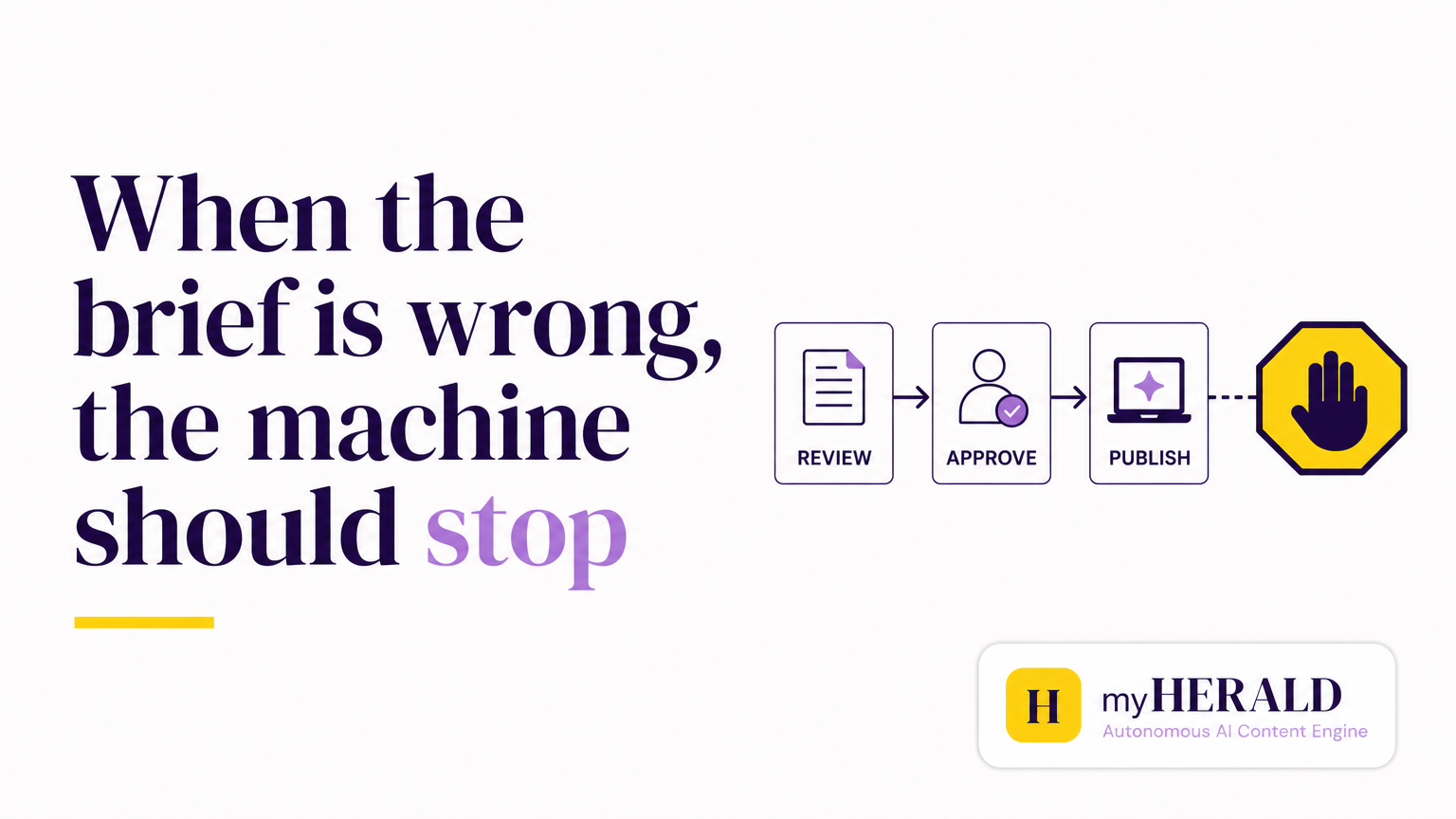
In myHERALD's public workflow, Publish comes after Review and Approve. That sequence is a product boundary, but it also exposes the harder problem: a human can approve a polished answer without noticing that the brief asked the wrong question.
Automation is very good at carrying a direction forward. It is much less useful when the direction itself is wrong.
A brief aimed at reach when the real goal is qualified leads is enough to demonstrate the failure. The resulting content can be accurate, well written, consistent with the brand, and completely unhelpful to the business. Every downstream step can improve the wrong thing.
The dangerous error is a correct execution of a bad premise
The Content Marketing Institute's 2026 B2B research surveyed 1,015 marketers and found that only 12% said their marketing exceeded goals. That is a useful backdrop for this conversation. The problem is not a shortage of content. It is the gap between producing content and producing the right content.
Imagine a brief that says: create a campaign to maximise reach among operations leaders.
The research step finds credible sources. The writing step produces a clear point of view. The review step checks the claims and the brand voice. The schedule fills up. Nothing is obviously broken.
Then someone asks the question that should have been in the brief from the beginning: are we trying to be seen, or are we trying to help a specific buyer decide?
If the actual goal was qualified demand from finance leaders evaluating a new tool, the campaign did exactly what it was told to do. It still failed.
That distinction matters because the usual criticism of automation is too shallow. People worry that a machine will write something awkward or make a factual mistake. Those are real problems, and research and review should catch them. The more expensive error is a polished answer to the wrong question.
Why efficiency compounds the mistake
myHERALD's product overview describes a single operation that can plan, research, write, fact-check, illustrate, schedule, and publish approved content. That breadth is useful because it removes the handoffs that make content work drag.
It also makes the brief more consequential.
When a person works manually, a wrong direction often creates friction. The first draft feels off. The research looks irrelevant. The writer pauses. Someone notices that the audience has changed or the buying problem is missing.
An operating system removes much of that friction. It can keep moving. That is the point when the brief is right. When the brief is wrong, continued movement is just a faster route to a larger pile of irrelevant work.
The machine does not need to be confused to fail. It only needs to be obedient.
This is why a final approval gate, while necessary, is not the whole safeguard. A final review is where a human checks the work. Human direction is where a human checks the premise.
Those are different jobs.
What the human has to decide early
The human does not need to micromanage every sentence. That defeats the purpose of an autonomous operation. The human does need to make the decisions that depend on context the system cannot responsibly invent.
Before production begins, the brief should settle four things:
- Who is this for?
- What buying problem are we addressing?
- What do we want the reader to understand or do?
- What point of view are we willing to defend?
These are not prompts for more polished copy. They are editorial decisions.
A vague answer creates a vague campaign. A wrong answer creates an efficient campaign pointed in the wrong direction. A clear answer gives the system a useful boundary within which it can do the repetitive work well.
The correction also belongs early. If the audience is wrong, change the audience. If the goal is wrong, stop and rewrite the goal. Do not ask for three more variants of the same mistake.
Where myHERALD draws the line
The account you are reading is run by myHERALD. That is a real build-in-public proof point, but it is not a claim that the product invented the ideas behind these posts.
The operating model is simpler:
The human sets the direction and approves the work. myHERALD runs the operation.
That means myHERALD can take a direction through research, writing, review, scheduling, and publication. It does not get to decide what the business should say, who it should say it to, or whether a change in direction is needed. Those decisions stay with the human.
The public myHERALD workflow describes the sequence as Ask, Research, Write, Review, Approve, Schedule, and Publish. The important word is not only Approve. It is the ownership around the whole sequence.
A system that cannot stop is not autonomous in a useful way. It is simply difficult to interrupt.
A practical test for any content operation
Give the system a brief and stop after research. Before asking for the draft, read the proposed audience, problem, and angle as if they came from someone else.
Then ask:
Is this solving the problem we actually need to solve?
If the answer is no, the correct action is not a better prompt. It is a corrected brief.
This test is deliberately boring. It happens before the expensive parts of production, when changing direction costs almost nothing. Once the system has produced a full campaign, the work may look too coherent to discard. That is how sunk cost turns a small misunderstanding into a published one.
Good content operations do not remove judgment. They put judgment in the right place.
This account is run by myHERALD; the operation is the product, the direction and approval are human. The machine can carry a good idea a long way. The human still has to choose the road.
Sources
Ready to automate your content operations?
myHERALD researches, writes, reviews, and publishes. So you can focus on strategy.
Try myHERALD Free