The before-and-after is the proof
“We improved the process” sounds finished. It gives the reader nothing to inspect. What was wrong before? What changed? What did the change affect, and what remains unknown?
Without a starting point, an improvement claim is an assertion delivered in a confident tone. That is where most content claims lose their credibility.
A documented sequence gives an outcome somewhere to stand.
Output is easy to show. Change is harder.
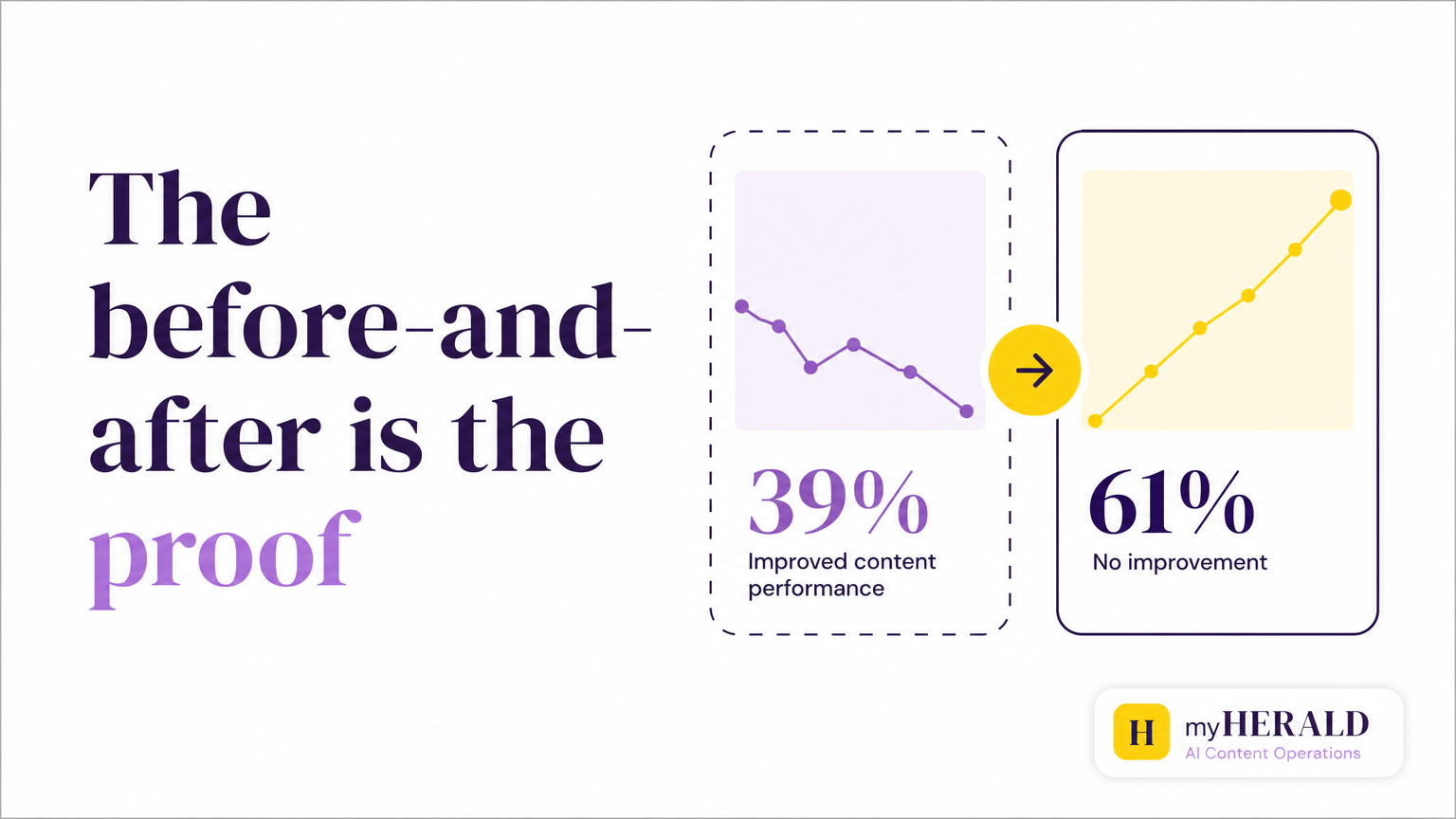
Content Marketing Institute and MarketingProfs' 2026 B2B research found that 87% of respondents saw improved productivity from AI content creation and 58% saw improved content quality, yet only 39% reported improved content performance. The study separates speed and polish from results.
That distinction matters for any content operation. A faster process can produce more drafts. A cleaner draft can be easier to approve. Neither fact, on its own, tells a buyer whether the work earned attention, clarified a decision, or moved someone closer to action.
Performance claims need a visible starting point.
Forrester's 2026 B2B predictions describe the same shift from assertion to evidence: buyers are demanding transparency, validation, and measurable outcomes, and Forrester predicts that more than half will use trials as a critical decision point. Forrester's analysis is about buying behaviour, but the lesson applies earlier in the journey. Content has to make its own claims inspectable before it can ask the reader to inspect someone else's product.
A credible before-and-after has three parts
A proof-bearing story shows the starting condition, the intervention, and the observed change. Remove any one of the three and the story becomes difficult to verify.
-
Before: define the starting condition.
Describe the actual problem, not a broad category. A weak starting point is “our content needed work.” A useful one identifies the failure: the brief had no named audience, the draft contained an unsourced claim, the review process produced the same correction repeatedly, or the article answered the wrong question.
Include the relevant constraint. Was the piece written for a founder with one hour to review it? Did the claim depend on a third-party study? Was the goal comprehension, qualified traffic, approval speed, or something else? The constraint tells the reader what kind of improvement is realistic.
-
Work: show the decision that changed the piece.
The intervention is not “we used AI” or “we optimised the workflow.” Those descriptions hide the useful part. Explain what someone decided to do differently and why.
Perhaps the team replaced a generic opening with a documented observation. Perhaps it added a source beside every borrowed statistic. Perhaps it removed three claims that could not be verified. Perhaps the editor changed the audience from “marketers” to “solo founders at companies with fewer than five people.” The work is where judgment becomes visible.
-
After: state the observed change and its limits.
Show the new condition in terms the reader can recognise. The result might be a published revision, a shorter approval cycle, higher source coverage, clearer comprehension in user interviews, or a change in qualified behaviour. Name what was measured and over what period when that information exists.
Then say what the evidence does not prove. A better sourced article does not automatically prove higher conversion. A faster approval does not prove stronger demand. A positive comment does not establish a pipeline result. Limits do not weaken the story. They tell the reader that the claim has been kept inside the evidence.
Make the work inspectable
The strongest proof is usually a compact audit trail, not a dramatic reveal. A reader should be able to follow the path from problem to decision to result without needing access to the entire production history.
An evidence-bearing version of a content claim might look like this:
The first draft repeated a product claim without a source. We replaced it with a narrower statement supported by the original study, removed two claims we could not verify, and tracked qualified clicks for the next reporting period. The revision improved source coverage. We do not yet know whether it improved pipeline.
That example is deliberately modest. It shows the starting flaw, the work performed, the observable change, and the unanswered question. It also avoids borrowing certainty from a metric that was never measured.
For teams documenting a real change, four artefacts usually do enough work:
- the original draft, brief, or baseline;
- the revised version, with the meaningful change visible;
- the source or decision record behind the change;
- the metric, observation, or reviewer feedback used to judge the result.
The goal is not to publish every internal note. It is to expose the part of the method that supports the conclusion. A visible starting point and a visible result are useful because they compress a large amount of context into something another person can examine.
Measure the result that matches the claim
Proof becomes weaker when the metric changes halfway through the story.
If the claim is that a content process became more reliable, measure something related to reliability: fewer repeated corrections, a higher share of claims with sources, or a more consistent approval outcome. If the claim is that content became more useful to buyers, look for evidence in buyer behaviour or direct feedback. If the claim is that a piece became clearer, test comprehension instead of pointing to its word count.
The metric does not need to be impressive. It needs to answer the question the claim creates.
A simple evidence record can use four lines:
- Claim: what changed?
- Baseline: what was true before?
- Signal: what did we observe after the change?
- Limit: what can this evidence not establish?
This format also prevents a common error: using an easy metric as a substitute for a meaningful one. More output is not the same as more impact. More impressions are not the same as more trust. A shorter review cycle is not the same as a better decision.
Content Marketing Institute's 2026 research makes this separation visible. It reports that 65% of effective B2B marketers cite content relevance and quality as a factor that moved the needle, but the useful takeaway is not to repeat the percentage as a promise. It is to ask what relevance and quality looked like before the change, how the team improved them, and what evidence shows that the audience noticed.
Show judgment, especially when AI is involved
The work behind a result matters even more when the content was produced with AI assistance. The Nuremberg Institute for Market Decisions found in two experiments that identical ads were judged more negatively when labelled AI-generated, including lower willingness to click, research, or purchase. The NIM research does not show that all AI-assisted content fails. It does show why undisclosed or unexplained production can become a trust problem.
The answer is not to make the tool the story. The answer is to make the judgment visible.
Show the direction that came from a human. Show the source that survived review. Show the claim that was narrowed because the evidence did not support the larger version. Show the result without pretending it proves more than it does.
That is what turns a polished outcome into a credible one. The reader can see the condition you started with, the choices made along the way, and the change you can actually defend.
A before-and-after is not a decorative case study format. It is a small, practical standard for making claims accountable. If the reader cannot see what changed, there is an outcome. There is not proof yet.
Sources
Ready to automate your content operations?
myHERALD researches, writes, reviews, and publishes. So you can focus on strategy.
Try myHERALD Free