A content queue is a decision system
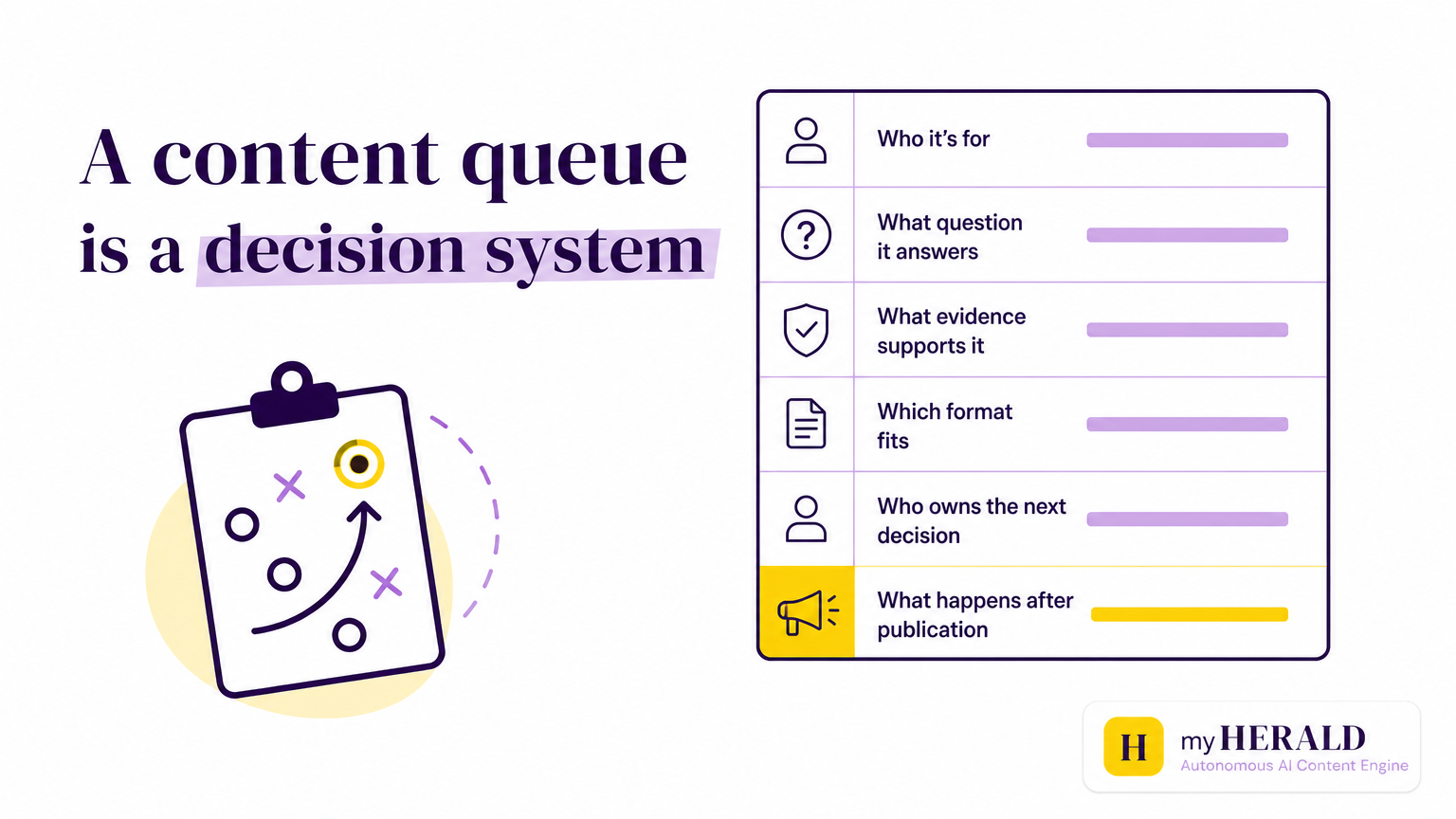
A content queue is a decision system, not a list of post ideas. It records who a piece is for, what question it answers, what evidence supports it, which format fits, who owns the next decision, and what happens after publication.
That distinction matters for solo marketers and founders because a calendar only answers “when?” A working queue also answers “why this?”, “why now?”, “what is missing?”, and “what happens next?”
What is a content queue?
A content queue is a structured set of content items, each carrying the context and decisions required to move from idea to publication. The smallest useful unit is not a title. It is an idea connected to an audience problem, evidence, platform, owner, review gate, schedule, and learning note.
A calendar is a timing view. A queue is an operating model.
That difference is easy to miss. A calendar can show twenty posts scheduled for the month while telling you almost nothing about their relevance, proof, or readiness. A decision system makes editorial judgment visible before a draft consumes time.
The model is practical for a team of one:
idea → audience and problem → evidence → format and platform → owner → review gate → schedule → learning
Each arrow represents a decision. If the decision is not recorded, someone will have to make it again later, usually when the deadline is closer and the cost of changing course is higher.
The eight fields every queue item needs
A spreadsheet is enough to start. Add one row per content item and give each row these fields.
| Field | Question it answers | Example |
|---|---|---|
| Idea | What are we trying to say? | A queue should preserve editorial judgment |
| Audience and problem | Who needs this, and what are they stuck on? | A founder with too many unprioritized ideas |
| Evidence | What supports the claim? | A customer question, internal observation, or named source |
| Format and platform | Where will this idea make sense? | LinkedIn text post, blog explainer, or visual carousel |
| Owner | Who makes the next decision? | Founder, editor, or subject-matter owner |
| Review gate | What must be true before approval? | Claim checked, audience clear, format native |
| Schedule | When is it relevant to publish? | A date tied to a campaign or learning cycle |
| Learning | What will we record afterward? | Which audience question produced useful replies |
The evidence field deserves special attention. “We should post this” is not evidence. Evidence can be a source, a recurring customer question, a documented project lesson, or a clearly labeled point of view. The standard changes with the claim, but it should be explicit.
For search and answer visibility, HubSpot’s official AEO documentation recommends tracking brand visibility, competitor presence, citations, cited content types, and recommendations across repeated analysis cycles. That is a useful model for content queues too: the item should retain what was learned, not disappear into a published archive.
Five decisions for weekly triage
A useful weekly review is a set of decisions, not a tour of the calendar.
Research now
Choose this state when the problem is relevant but the evidence is incomplete. Write down the question to investigate and the minimum evidence needed to move forward.
This prevents a common failure mode: drafting a confident answer and searching for support afterward. Research should shape the argument, not decorate it.
Draft now
Use this state when the audience, question, point of view, and evidence are clear enough to write. Drafting is cheaper when the decisions upstream are settled.
A draft can still change. It should not have to discover its purpose while being written.
Schedule
Schedule an item only when it has passed its review gate. The gate might check factual accuracy, audience fit, platform shape, and whether the piece says something distinct from recent work.
Scheduling is a commitment. Treat it as the outcome of a decision, not the default destination for every idea.
Hold
Hold an item when it is sound but mistimed, too close to another piece, or dependent on context that has not arrived yet. A hold is different from indecision. It has a reason and a review date.
Without a reason, “later” becomes a quiet form of avoidance.
Kill
Kill an item when the question is weak, the evidence does not support the claim, or the format would force the idea into a shape it does not suit. This is useful work. A queue gets clearer every time an item is removed for a stated reason.
Three gates before publication
Most content systems need three simple gates.
The first is the relevance gate: can the intended audience recognize the problem quickly, and does the piece answer a question they actually have?
The second is the evidence gate: are the important claims supported by a named source, a first-party observation, or a clearly stated opinion? LinkedIn’s marketing publication has been emphasizing business impact over vanity metrics, which is a good reminder to connect content to a meaningful audience or business question instead of collecting impressions as the only proof.
The third is the format gate: does the idea belong on this platform in this shape? A strong argument can fail when it is copied unchanged across a blog, a short post, and a visual feed. Platform fit is part of the editorial decision, not a final formatting task.
For example, a detailed explanation may belong in a blog, while the social adaptation should carry one sharp claim and enough context to stand alone. The queue should preserve that relationship so the adaptation does not become a disconnected rewrite.
Add the learning note after publication
Publication is not the end of the item. It is the start of the learning record.
The note does not need to become a dashboard project. Record what changed:
- Did the intended audience respond to the problem or to the opinion?
- Did the evidence make the piece more credible?
- Did the format invite useful replies, saves, or shares?
- Did the piece create a better question for the next item?
The point is not to chase a universal engagement formula. It is to improve the next decision. If a post received attention but no substantive response, that is different from a post that generated a useful customer question. Both are signals, but they lead to different choices.
HubSpot’s guidance is relevant here because it treats visibility analysis as a repeated cycle of monitoring and recommendation. A queue should work the same way. Each published item leaves behind a small amount of context for the next one.
A practical example
Imagine a note that says: “Write about content consistency.”
That note is too vague to triage. It does not identify a reader, a problem, or a useful claim.
A decision-ready version might say:
“A founder carrying marketing alongside the business needs a queue that reduces repeated editorial decisions. Explain the difference between a calendar and a decision system, using a simple eight-field schema. Support the section on measurement with HubSpot’s official AEO guidance. Adapt the argument into a LinkedIn post and a short visual caption. Review for evidence, audience fit, and platform shape.”
The second version does not guarantee a good article. It does something more useful first: it makes the work possible to evaluate.
Common queue failures
A queue becomes less useful when it has:
- Titles and due dates, but no audience or problem
- Drafts with sources added after the argument is finished
- A status called “ready” with no definition
- One owner for publishing but nobody responsible for the next decision
- Metrics without a learning question
- A permanent holding area where weak ideas never get removed
The fix is not more fields for their own sake. Every field should preserve a decision that would otherwise be re-made from memory.
Frequently asked questions
What is the difference between a content calendar and a content queue?
A calendar organizes publication dates. A content queue organizes the decisions that move an item from idea to publication and learning. A calendar answers when. A queue also answers why, for whom, with what evidence, and what happens next.
How many fields should a content queue have?
Start with eight: idea, audience and problem, evidence, format and platform, owner, review gate, schedule, and learning. Add a field only when it preserves a decision you repeatedly have to reconstruct.
Does a content queue need a dedicated tool?
No. A spreadsheet works if each row carries the required context and the statuses have clear meanings. A dedicated tool becomes useful when research, drafting, review, scheduling, and learning are split across places and the reasoning gets lost between them.
When should an idea be removed?
Remove it when the audience problem is unclear, the evidence does not support the claim, the format is wrong, or the idea no longer earns a place in the current plan. A shorter queue with visible reasons is healthier than a large backlog that nobody trusts.
A good content queue does not make every idea publishable. It makes the next decision obvious, and it preserves enough context that the decision does not have to be made from scratch next week.
Sources
Ready to automate your content operations?
myHERALD researches, writes, reviews, and publishes. So you can focus on strategy.
Try myHERALD Free