Approval is a product feature
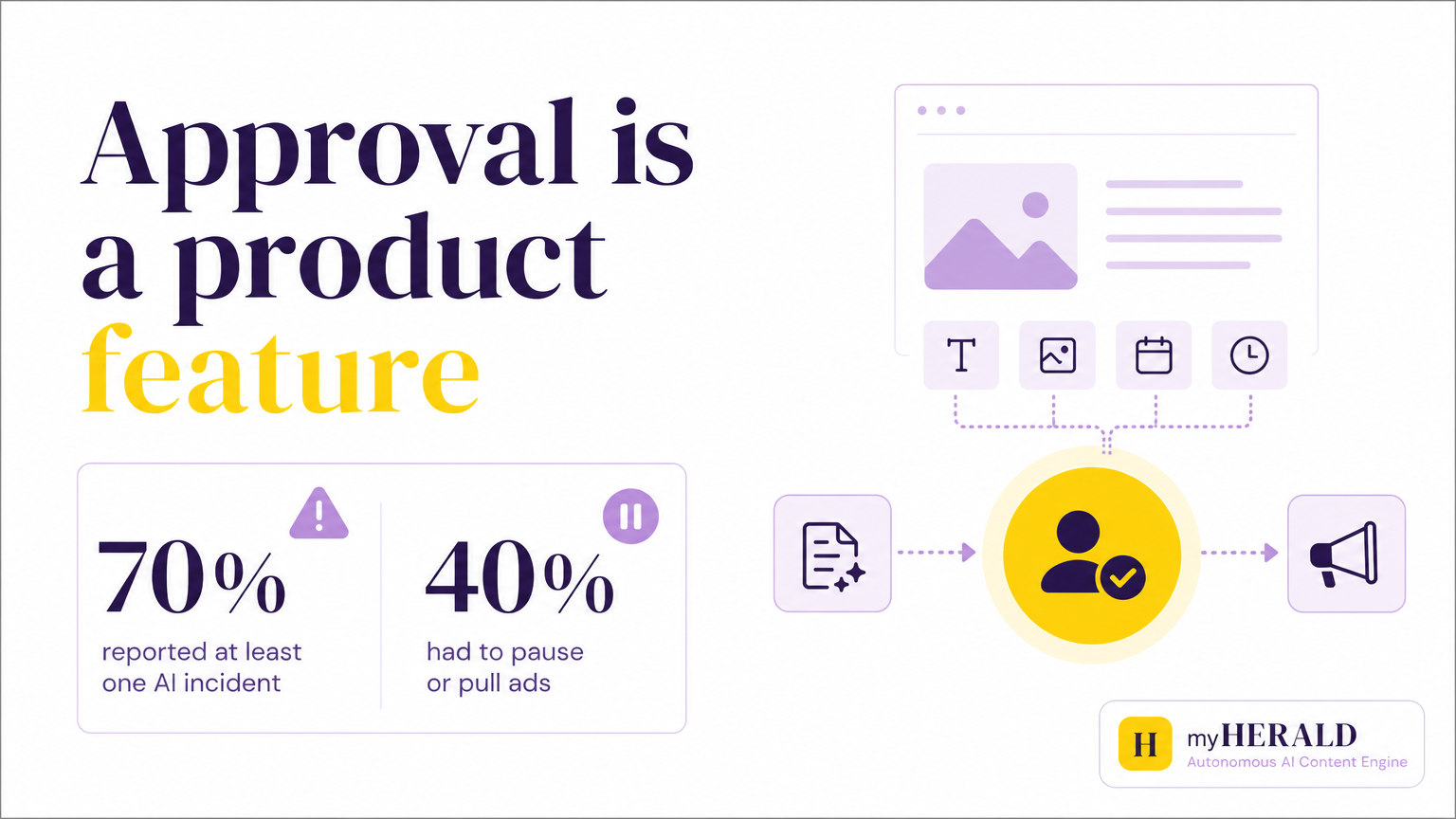
Approval is a product feature because it assigns authority at the exact point where content becomes public. In IAB/Aymara's survey of 125 US advertising executives, 70% reported at least one AI incident and 40% had to pause or pull ads. That is a workflow problem, not only a model problem. IAB
Approval is the control boundary
AI can research, draft, format, schedule, and prepare a week of content. It cannot own the consequences of publishing that content. The person responsible for the brand still needs a clear place to inspect the work and say yes.
That is what approval does when it is designed properly. It is a permission model for public speech. It separates operational speed from editorial authority.
The distinction matters for small teams. A founder or marketer-of-one does not need another tool that creates a draft and leaves the rest of the work scattered across documents, chat messages, and a publishing calendar. They need the repetitive work handled while the meaningful decision stays visible.
What the gate protects
IAB/Aymara found that 70% of surveyed advertising executives had encountered hallucinated, biased, inappropriate, or off-brand AI output. Forty percent had to pause or pull ads, and more than one-third reported brand damage or public-relations issues, according to the same survey. Only 6% said current safeguards were enough.
Those figures do not prove that every AI workflow is unsafe. They show something more useful: the cost of a bad output is often paid after the generation step, when the content has already moved toward publication.
A review gate puts the decision before that cost. It gives the accountable person a chance to correct a claim, change the angle, remove a phrase that does not sound like the company, or stop the piece entirely. That is judgment, not clerical delay.
A workflow people can actually trust
The useful pattern is simple:
Plan → research → draft → review → approve → publish
The value comes from keeping those stages connected. The system can carry context from the brief into the draft, show the target and platform-aware preview during review, and retain a record of what happened. The human can edit inline, request a revision, or approve.
myHERALD is built around that model. Its product overview describes a full content operation covering planning, research with fact-checking, writing, illustration, review, scheduling, and publishing, with explicit human approval before anything goes live. myHERALD Product Overview
The product surface has become more concrete over time. The April 21, 2026 changelog added a timestamped activity log for edits, approvals, and publishing, and made approval gating consistent across publishing targets. The May 21 review update added editable title, target, body, and rationale fields with a platform-aware preview. myHERALD Changelog
Those details matter because trust is easier to maintain when the handoff is visible. Who changed the draft? Who approved it? What exactly was approved? A responsible workflow can answer without reconstructing the story from memory.
Automation should remove work, not ownership
The strongest version of content automation is not the one that removes every human action. It is the one that removes the actions that do not need human judgment.
myHERALD's Autopilot can plan a week and draft content for each platform, but the June 12, 2026 release kept every piece behind approval. That is the right division of labor. The operation runs. Direction and approval remain human. myHERALD Changelog
This also changes how edits should be understood. An edit is not evidence that automation failed. It is part of the product's learning loop. The same changelog documents that approved-draft edits become future preferences, so a correction can reduce the amount of correction required later.
For a lean team, that is a better promise than "never review anything." The first promise is fantasy. The second is useful: review the decision that matters, and let the system absorb the recurring preferences around it.
What buyers should inspect
PwC's 2025 Responsible AI Survey covered 310 US business leaders and describes oversight adapting as organizations work with autonomous systems. The practical buying question is not whether a vendor uses the word autonomous. It is whether the workflow makes responsibility legible. PwC
Before buying an AI content system, ask four questions:
- Where does the final approval happen?
- Can the responsible person edit the actual item before publication?
- Is the approval tied to a specific version, target, and timestamp?
- Does the system learn from approved edits without quietly turning approval into an optional setting?
The answers reveal whether approval is a real product capability or a sentence in a policy page.
A system that generates quickly but hides the handoff creates a new class of work: checking what happened after the fact. A system that makes the handoff explicit lets a small team move faster with a clearer boundary around what it is willing to publish.
The feature that keeps the brand yours
myHERALD's approval gate is not a brake on the content operation. It is the point where the operation meets accountability.
AI prepares the work. A person decides what represents the company. The product earns its place by making that division fast, visible, and repeatable.
That is why approval belongs in the product roadmap, the review interface, the activity log, and the buying criteria. If a system can produce a public statement, it needs to show who is authorized to make it public.
Sources
Ready to automate your content operations?
myHERALD researches, writes, reviews, and publishes. So you can focus on strategy.
Try myHERALD Free