Why AI content sounds templated, and the two layers that fix it
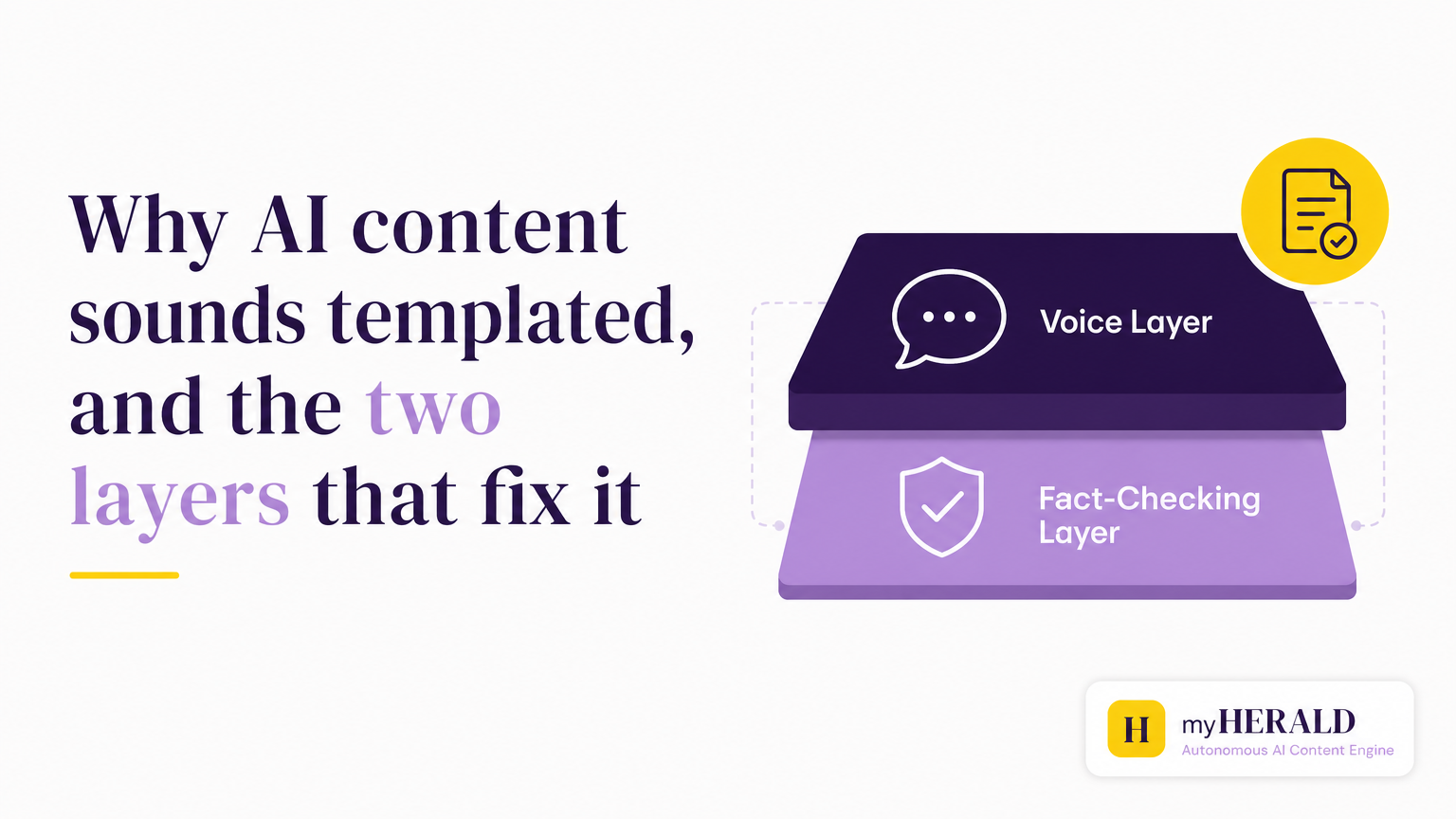
Generic AI writing is not a talent problem or a model problem. It is an operations problem. When you hand a model a vague prompt with no defined voice and no verified facts, it returns the statistical average of everything it has read. Fix that with two layers built into your pipeline: a voice layer that forces specificity, and a fact-checking layer that grounds the output in real data.
We ran that claim as an experiment on this account. Holding the models, the budget, and the topics constant and changing only the writing instructions, blind position-swapped judges scored the new prompt higher on pure craft in both passes, by 0.31 and 0.93 points on a ten-point scale. Same model, same cost per piece. The brief was the variable.
Why AI content sounds templated
A language model predicts the most likely next word. Feed it a generic instruction like "write about AI content marketing" and it produces the most likely paragraph, which is the average of the thousands of near-identical posts already in its training data. That average has a sound, and people recognize it.
Hookline's 2025 AI in Content Marketing Report found that 82.1% of Americans can spot AI-generated content at least some of the time, rising to 88.4% among younger readers. They are not spotting grammar mistakes. They are spotting sameness. The tells are consistent: openers like "In today's fast-paced world," hedged claims like "many businesses experience," and filler verbs like "leverage," "streamline," and "game-changer." Three or more of those in one piece and the reader files it as machine output before finishing the first paragraph.
Being spotted is not a neutral event. In the same survey, 50.1% said they would think less of a writer who uses AI, and 40.4% would think less of a brand.
So the raw problem is not that the model writes badly. It writes plausibly. Plausible and generic are the same sentence.
The real gap is enforcement, not documentation
Most teams already own the thing that would fix this, and it sits unused. Demand Metric's brand consistency research with Lucidpress, now Marq, surveyed over 400 organizations and found that 95% have brand guidelines while only 25% enforce them consistently. The same research puts the cost of that gap plainly: 60% of marketing material does not conform to the guidelines the organization already wrote.
There is a second, quieter failure. Traditional voice guides are written for humans to interpret: "bold yet approachable," "professional but warm." A person can read that and make a judgment call. A model cannot. It has no way to act on an adjective. It needs rules it can execute, not a mood it should channel.
That is the whole reframe. Quality is not a writing problem you solve draft by draft. It is a system you build once and run every time.
Layer 1: voice as an executable constraint
The voice layer turns your brand into rules a model can actually follow. Replace adjectives with behavior.
- Structural limits. Maximum sentence and paragraph lengths, a fixed point of view (we write in first-person "we"), a required reading level. These are checkable, so they get followed.
- A banned-words list. Ours bans "seamlessly," "game-changing," "revolutionary," "unlock the power," and the rest of the corporate-jargon starter pack. A banned list does more for voice than a paragraph of aspiration ever will.
- A "sounds like us" library. Paired good and bad examples of the same idea. Our own writer instructions carry exactly one pair: a short passage written the way we want it, next to the flat, checklist version of the same point. It is the highest-leverage line in the whole prompt, because a model can copy a shape it can see and cannot copy an adjective. Show, do not describe.
None of this is editing. Editing happens after a draft goes wrong. This is quality control built into generation, so the draft comes out closer to right the first time.
Layer 2: fact-checking as infrastructure
A perfect voice attached to a made-up statistic is worse than useless. It is confidently wrong in your own tone. This is the layer most people skip, and it is the one that protects the trust the voice layer earns.
Two rules make it a system rather than a vibe check:
- Treat every statistic, quote, and case study as fake until verified. Set a verification threshold, we use ten minutes. If a claim cannot be traced to a real source in that window, it does not ship.
- Feed the model your material first. Customer interviews, meeting notes, sales calls, your own product data. Then instruct it to structure and edit that material rather than invent from scratch. A model given real inputs and told to arrange them does not need to hallucinate. A model given a blank prompt will fill the gap with plausible fiction.
There is a third rule we learned the hard way, and it is the one most people miss: verifying a claim internally is not the same as attributing it for the reader. A number that your researcher traced to a real source, then dropped into a sentence with no attribution, is unverifiable to the person reading it. Name the source in the sentence. On a channel where a link would hurt reach, naming it still costs nothing.
Grounding is what makes the content yours in the literal sense: it now contains things only you know.
Why this is an operations problem, not a writing one
The market data shows the split clearly. Jasper's State of AI in Marketing 2026, a survey of 1,400 marketing professionals, found that 91% of marketing teams now use AI, up from 63% a year earlier, while the share who can actually demonstrate a return fell to 41% from 49%. Adoption went up. Proof went down. The blocker the report names is not access to AI, it is governance: running it reliably and on-brand.
Faster is easy. Better is not, because better does not come from the prompt you typed today. It comes from the system running underneath every prompt.
Treat voice and fact-checking as one-off editing tasks and you pay the cost on every single piece, forever. Treat them as repeatable layers in the pipeline and the cost is paid once. That is the entire difference between AI content that sounds like everyone and AI content that sounds like you.
This is how we run this account. The direction and the approval are human. The operation, drafting, voice-checking, grounding, scheduling, is run by the product. The voice you are reading is not an accident of a good prompt. It is the output of a system.
The two layers, in practice
- Voice layer: structural limits, a banned-words list, and a good-versus-bad example library, enforced at generation, not patched at edit.
- Fact-checking layer: every claim unverified until sourced within a set time budget, your own data fed in first so the model arranges rather than invents, and the source named in the sentence so the reader can check it too.
Build both once. Run them on everything. That is the operations mindset, and it is what turns a generic model into a voice that is unmistakably yours.
Sources
Ready to automate your content operations?
myHERALD researches, writes, reviews, and publishes. So you can focus on strategy.
Try myHERALD Free