Your AI isn't the bottleneck, your workflow is
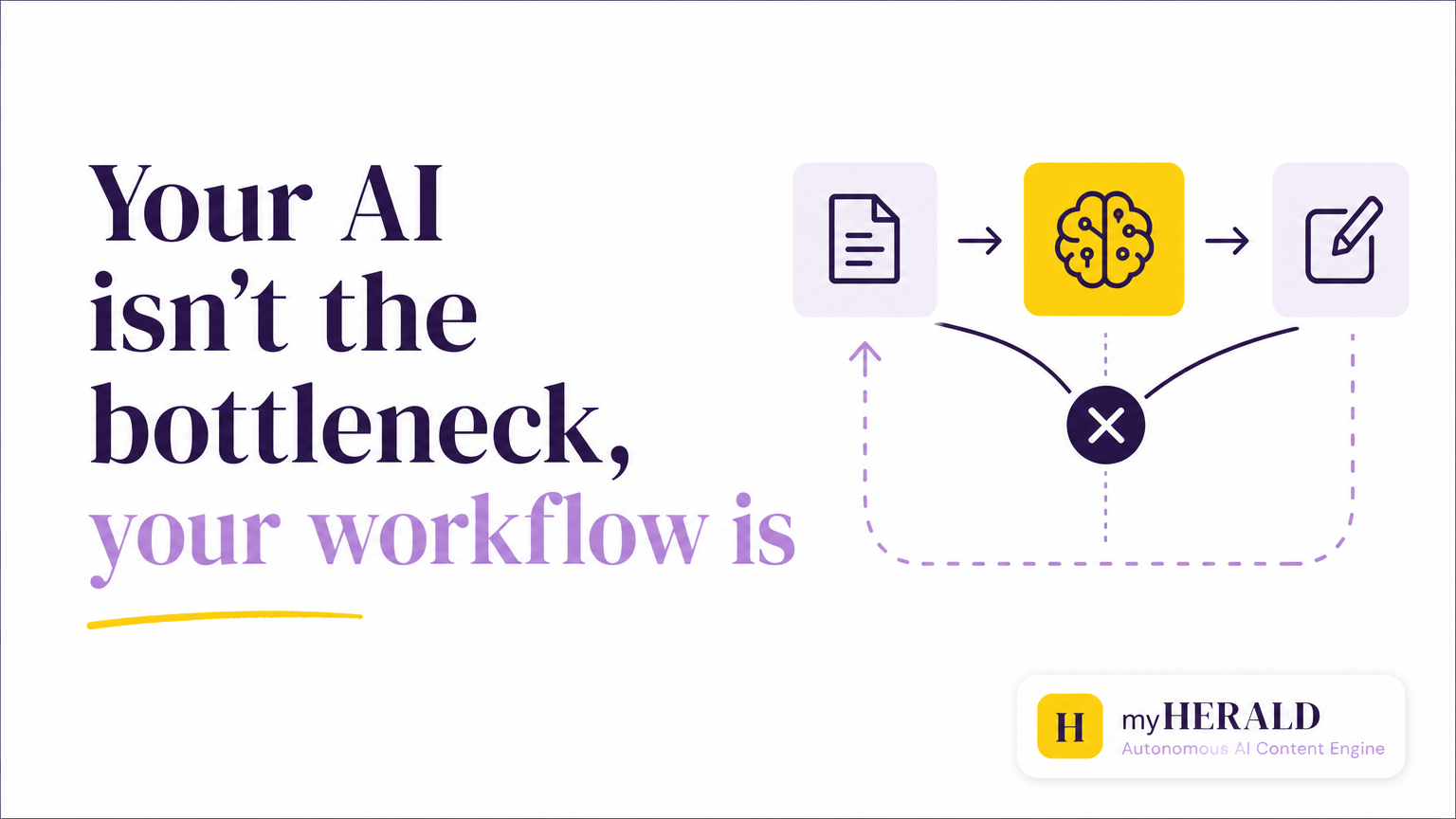
Ask a marketing team why their content is inconsistent and you will usually hear about the tools. The model isn't good enough. The prompts need work. Someone is waiting on a better integration. It is a comfortable answer because it puts the problem outside the room. But for most teams, the AI is already good enough. What is missing is the part nobody wants to own: a documented, repeatable workflow.
This is the quiet shift happening across marketing right now. The constraint has moved from the writing to the operations around it.
The objective changed, and most teams didn't notice
According to Jasper's State of AI in Marketing 2026, a survey of 1,400 marketers, scaling high-quality content is now the top objective marketers have for AI, up 2.4x compared to 2025. That is a meaningful reordering. A year ago the conversation was about whether AI could write at all. Now the question is whether you can do it consistently, at volume, without quality drifting.
The same report found that 75% of marketers point to operational readiness, not tool selection, as the bottleneck (Jasper, State of AI in Marketing 2026). Read that again. Three out of four are not blocked by their tools. They are blocked by the lack of a system to use them.
This matches what we see in practice. A capable model in an undocumented process produces capable output once, then something different next week, then nothing at all when the person who knew the unwritten steps is on holiday.
Capable AI is not the same as a capable workflow
McKinsey estimates that agentic AI could power up to two-thirds of marketing activities (McKinsey). Take that seriously for a moment. If two-thirds of the work can be handled by AI, the value you add is no longer in doing the work. It is in designing the process that the work runs through.
That is an operations skill, not a writing skill. The teams pulling ahead are not the ones with the best prompt. They are the ones who have written down what good looks like, where the source material comes from, who reviews it, and what gets published when. The AI fills the steps. The workflow is the thing that makes the steps repeatable.
The uncomfortable part: a process you keep in your head is not a process. It is a habit, and habits break under load.
Why owned channels make this worth doing
You might reasonably ask why bother building a system at all when you could just post more. The answer is in where the value is settling. HubSpot's 2026 State of Marketing report found that 61% of marketers say the industry is in its biggest disruption in 20 years, and that brand point of view and owned channels are now the moat (HubSpot, 2026 State of Marketing).
When everyone can generate competent content instantly, competent content stops being a differentiator. What is left is a consistent point of view delivered reliably on channels you control. That is not a volume game. It is a consistency game, and consistency is an operations problem.
A weekly cadence beats daily volume
Here is the part that runs against instinct, especially for the marketer-of-one. The goal is not to publish every day. The goal is to publish well, on a schedule you can actually keep, indefinitely.
Daily volume sounds ambitious. In practice it is the fastest route to burnout and quality drift. You run out of considered things to say, so you start saying unconsidered things. A weekly cadence, by contrast, gives you room to think, to draft, to edit, and to repurpose one strong idea across every channel without the work ballooning.
A workable weekly loop looks like this:
- One canonical piece. Write the blog first. It is the deepest version of the idea and the source of truth for everything else.
- Repurpose, do not retype. Adapt the canonical piece to each platform's format and length. Same core message, rewritten to fit. Never copy-paste, never truncate.
- One review step. Define what good looks like once, then check every piece against it. This is where consistency actually comes from.
- Publish on a fixed schedule. A cadence you can keep beats a cadence that looks impressive for three weeks and then collapses.
The advantage of writing the long piece first is that the hard thinking happens once. Every adaptation after that is a format exercise, not a fresh act of creation. That is what makes a one-person operation sustainable.
Where to start
You do not need new tools. You almost certainly have a capable model already. What you need is a single page that describes your process: what you publish, how often, what good looks like, and who signs off. Then you run it for a month before you change anything.
The temptation will be to keep tuning the AI. Resist it. The leverage is not in the model anymore. It is in the operating system around the model, and that part is entirely within your control.
The bottleneck was never the writing. It was the workflow. The good news is that workflows are fixable, and unlike a better model, you do not have to wait for anyone to ship one.
Sources
Ready to automate your content operations?
myHERALD researches, writes, reviews, and publishes. So you can focus on strategy.
Try myHERALD Free