The asset that travels with the idea
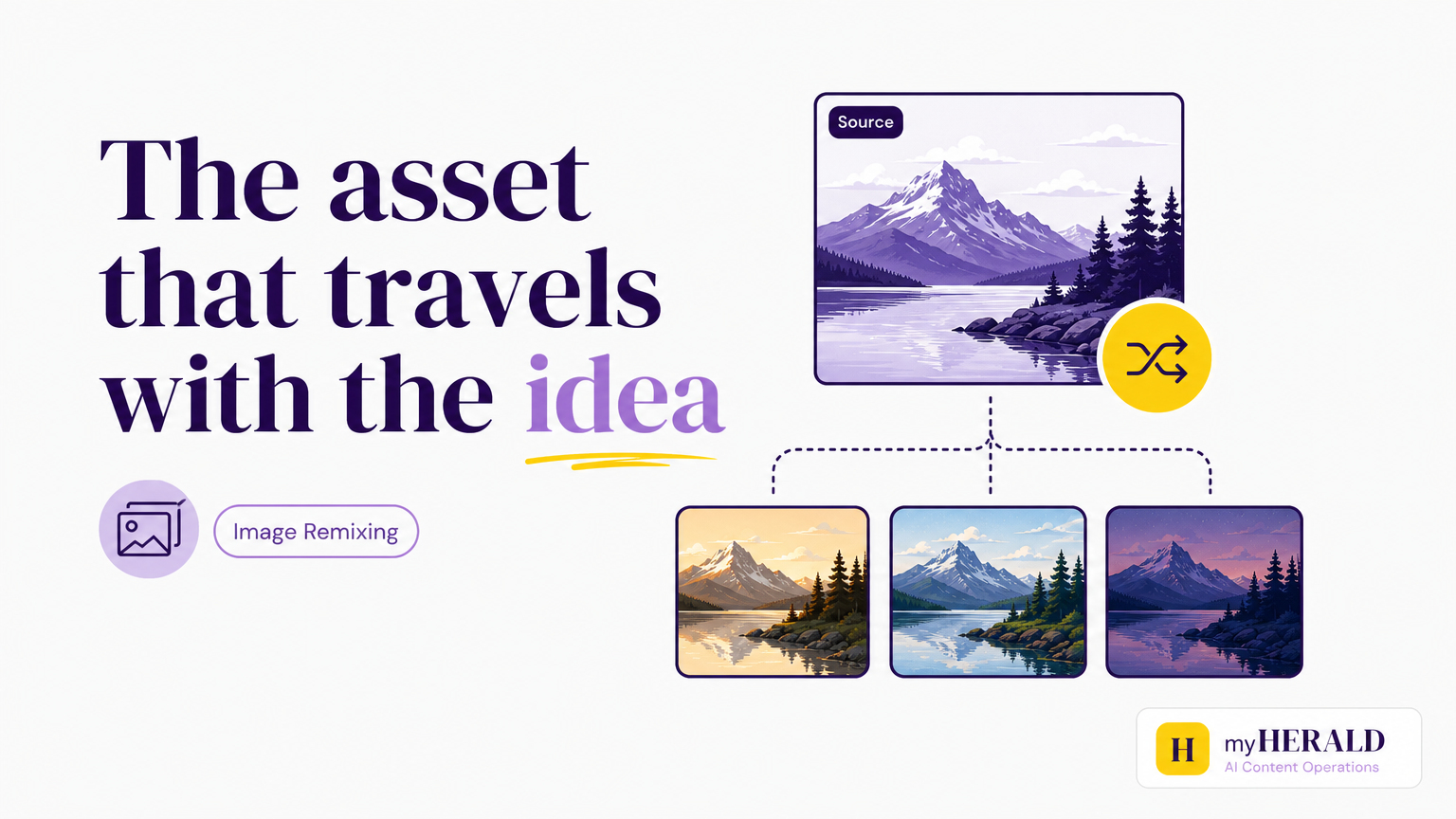
On June 3, 2026, myHERALD added image remixing from its library. The change lets you pick an existing picture and generate a new variation from it, rather than starting from a blank prompt every time, as the myHERALD changelog records.
It is a small feature with a useful consequence: the visual can stay attached to the idea as that idea moves through a campaign.
An idea rarely has one destination
A content idea may begin as a short brief, become a blog article, and then travel into several platform-native pieces. The words change. The format changes. The visual anchor should not have to disappear every time the destination changes.
That is where many lean teams lose time. The first asset gets made in one place, stored in another, and then separated from the content it was meant to support. A later variant starts from a blank page. Someone searches for the original file. Someone else makes a close approximation. The campaign still exists, but its visual memory has been scattered across folders, chats, and downloads.
The work is rarely difficult because one image is hard to create. It is difficult because the same decision has to survive the next five decisions.
The blank canvas is often the wrong starting point
The best starting point for a new campaign asset is often an existing asset that already earned its place.
myHERALD's Image Library was built around that idea. It gives a workspace a place to browse, upload, generate, and reuse images across content. The later remix feature adds the missing step: choose a picture that already belongs to the brand, then iterate on that look instead of describing it again from scratch.
That distinction matters. A blank prompt asks you to reconstruct the decision. A library asks you to continue it.
The difference is easy to miss when you are making one post. It becomes obvious when an idea needs a blog image, a social variant, a follow-up, and a new angle a week later. Reuse is not a shortcut for teams that ran out of time. It is a way to keep a good decision in the system.
Reuse is not repetition
Reusing an asset does not mean publishing the same file everywhere.
It means keeping the visual relationship intact while allowing the asset to change with the idea. The article may need a composed hero image. A social post may need a tighter crop or a different emphasis. A later piece may need a variation that feels related without looking copied.
The changelog describes the feature plainly: pick any picture in the library and generate a new variation, so you can iterate on a look instead of starting from a blank prompt every time. That is the useful boundary. The product is not trying to make every output identical. It is making continuity easier to maintain.
For a lean team, that continuity carries more weight than a large asset catalogue. A hundred disconnected files do not create a visual system. A smaller set of recognisable choices, kept close to the ideas they support, is more useful.
The asset needs to travel with the idea
A practical way to think about campaign assets is to treat the idea and the visual as one working unit.
That unit should answer three simple questions:
- Which idea does this asset belong to?
- What should remain recognisable when the idea changes format?
- What can change without losing the connection?
These are editorial questions, not design software questions. They help prevent a common failure mode: preserving the file while losing the reason it existed.
When the asset remains attached to the idea, a new variant has a reference point. The writer does not have to explain the visual language again. The person reviewing the work does not have to compare a new image against a vague memory. The next iteration starts with context already present.
That is the part of asset reuse that usually gets overlooked. The value is not only in finding a file faster. The value is in keeping the decision that file represents available.
Fewer handoffs, fewer small decisions
The operational cost of visual work is often hidden in the handoffs.
Someone makes the first image. Someone names it. Someone exports it. Someone asks whether it is the latest version. Someone makes a new one because the original is difficult to find. None of these steps looks serious on its own. Together, they turn a small creative decision into a recurring coordination task.
A shared media library reduces that fragmentation by giving the asset a stable home. Remixing reduces the pressure to choose between two unhelpful options: repeat the original exactly or start over completely.
This is the quiet benefit. The team spends less effort recovering context and more effort deciding whether the new variation is right.
For a marketer working across several jobs, that difference matters. The goal is not to eliminate judgment from the process. The goal is to reserve judgment for the parts that actually need it.
Consistency still needs a human decision
A visual library can carry a choice forward. It cannot decide whether that choice still belongs in the campaign.
That remains an editorial call. The human sets the direction, reviews the result, and approves what moves on. myHERALD runs the surrounding operation, but the brand does not become a pile of automatically repeated images.
That separation is important. Automation is useful when it preserves context. It becomes noise when it removes judgment.
The strongest workflow is therefore simple: establish a visual anchor, keep it close to the content idea, create variations when the format calls for them, and review each one on its own terms. The system carries the starting point. The editor decides where it goes.
The better unit of work is an idea with memory
A content pipeline is easier to maintain when it remembers more than the words.
The image library gives the visual a place to remain available. Image remixing gives the team a way to continue from an existing choice. Together, they turn an asset from a one-time output into part of the idea's working memory.
That is what it means for an asset to travel.
It does not travel because every platform receives the same image. It travels because the visual decision remains available when the idea changes shape. The article, the post, and the next variation can feel related without forcing the team to recreate the relationship each time.
For small teams, that is a better definition of consistency: not repetition, but continuity with judgment.
Sources
- myHERALD Changelog, entries dated March 8, 2026, and June 3, 2026, covering the Image Library and image remixing from the library.
Ready to automate your content operations?
myHERALD researches, writes, reviews, and publishes. So you can focus on strategy.
Try myHERALD Free